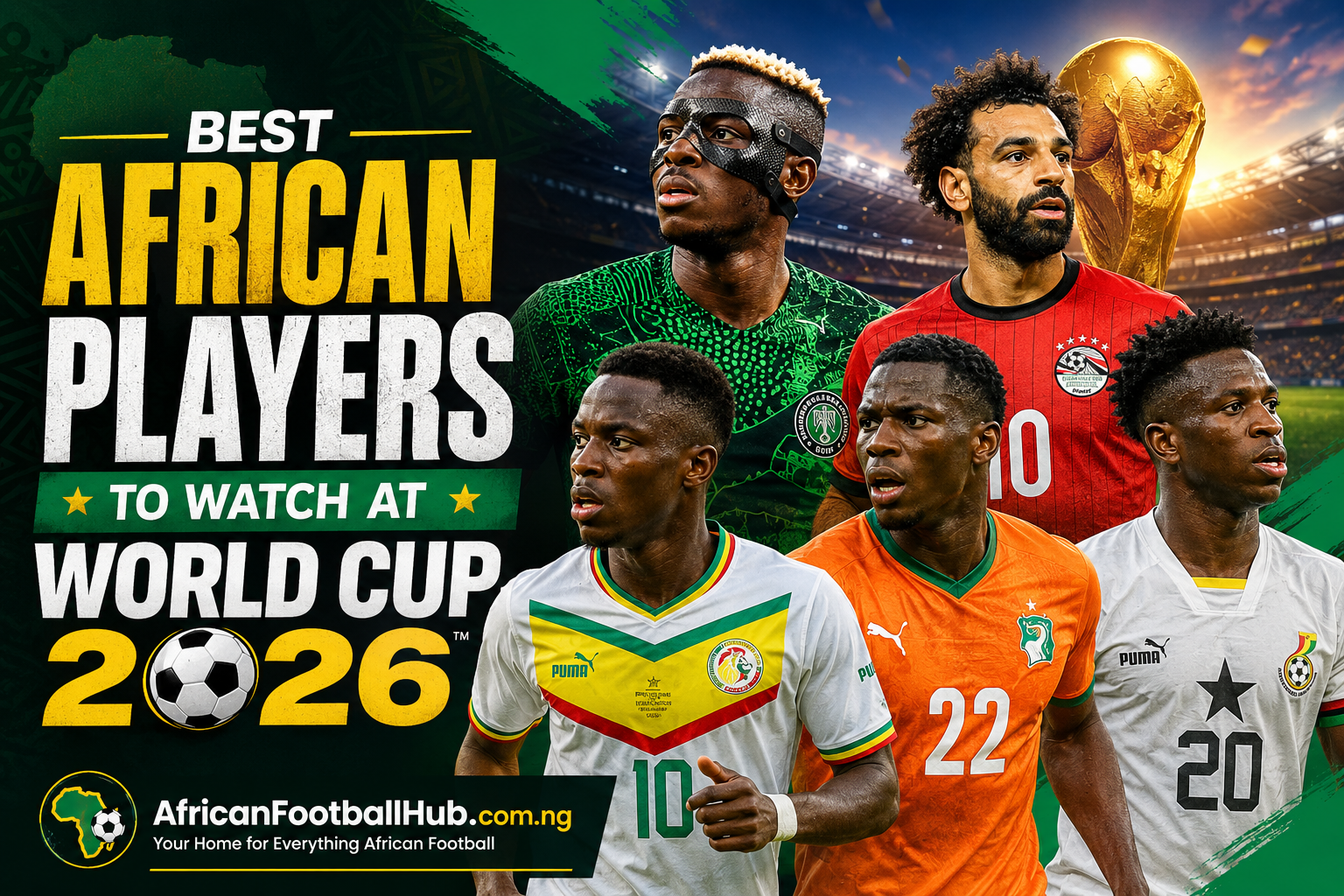
The best African players to watch at World Cup 2026 include some of the most gifted footballers on the planet right now — and a record 10 CAF nations are bringing them to North America. From Achraf Hakimi’s overlapping runs at full-back to Mohamed Salah’s unfinished World Cup business with Egypt, from Sadio Mané’s final chapter with Senegal to Antoine Semenyo’s explosive Premier League form, the continent has never sent more firepower to a single tournament. Here are the African stars who can define this World Cup.
Why This World Cup Is Africa’s Biggest Opportunity Yet
Ten African teams. The most ever. That is the headline number going into the 2026 FIFA World Cup in the United States, Canada and Mexico.
But the story goes deeper than quantity. Four years after Morocco became the first African nation to reach a World Cup semi-final, the entire continent’s expectations have shifted. The question is no longer whether African teams can compete with Europe’s best. Qatar 2022 answered that. The question now is how far they can go — and which players will make that happen.
The 2026 tournament features Algeria, Cape Verde, Côte d’Ivoire, DR Congo, Egypt, Ghana, Morocco, Senegal, South Africa and Tunisia. Across those squads, you will find Champions League winners, Premier League Golden Boots, AFCON legends and teenagers already playing for clubs like Bayern Munich and PSG.
These are the players to keep your eyes on.
1. Achraf Hakimi (Morocco) — Africa’s Best Player, Full Stop
There is no debate. Achraf Hakimi is the finest African player at this World Cup.
The PSG captain and Morocco skipper is not just Africa’s best right-back. He is one of the best full-backs in world football, full stop. Fast, aggressive, technically clean, and devastatingly effective in the final third. Only two players at AFCON 2025 created more chances than Hakimi’s 13 chance creations at the tournament. When Morocco need to unlock a defence, it usually happens down his channel.
At club level, Hakimi won the UEFA Champions League with PSG in 2024-25 — making him only the second African player after Cameroon’s Samuel Eto’o to lift the trophy three times. He arrives at this World Cup as the reigning continental standout, and with Morocco in eighth place in the FIFA rankings, the platform around him has never been better.
Morocco face Brazil in their Group C opener on June 13. That match alone could define the narrative of Africa’s entire tournament. If Hakimi can neutralise Vinicius Júnior on one side while causing problems going forward on the other, the Atlas Lions will have a genuine chance of a result.
Morocco got to the semi-finals in 2022. With Hakimi leading the way, they are built to go just as far — or further.
2. Mohamed Salah (Egypt) — Unfinished Business on the Biggest Stage
Mohamed Salah arrives at the 2026 World Cup with something to settle.
The Egyptian King has won everything at club level. Premier League titles. Champions League medals. Golden Boots. He became one of Liverpool’s all-time greats over nearly a decade at Anfield. But at international level, the story has been painful. Egypt went out of the 2018 World Cup in Russia without winning a single group game, despite Salah scoring twice.
Eight years later, Salah returns as the captain and leader of a much stronger Egyptian side. Egypt are in Group G alongside Belgium, New Zealand and Iran — arguably the most manageable group any African team received in the draw. Salah is closing in on Egypt’s all-time scoring record. He needs just two goals to equal the 69-goal record held by current head coach Hossam Hassan.
A muscle injury had threatened his build-up to the tournament, but he has recovered in time to lead Egypt’s charge. Omar Marmoush of Manchester City provides support alongside him — a partnership of established legend and hungry younger star that gives Egypt more attacking depth than at any previous World Cup.
If Salah stays fit and fires, Egypt reaching the knockout rounds for the first time in their history is not a fantasy. It is a very real possibility.
3. Sadio Mané (Senegal) — The Last Dance of a Legend
Sadio Mané has said this is his final World Cup. When a player of his quality announces a farewell, you watch every single game.
At 34, Mané is no longer the explosive winger who terrorised Premier League full-backs at Southampton and Liverpool for nearly a decade. His raw pace has faded. What remains is something different — and perhaps more dangerous. World-class touch. Elite vision. Relentless leadership. The ability to produce the decisive moment when it matters most.
At AFCON 2025, Mané was named player of the tournament. He scored a brilliant goal in a 1-0 semi-final victory over Egypt to help Senegal reach the final. He is Senegal’s all-time leading scorer with 55 international goals. The Lions of Teranga have never gone to a World Cup with a better squad — and Mané remains the heartbeat of everything they do.
Senegal are in Group I: France, Norway and Iraq. Facing France in the opener on June 16 is a rematch of the most famous result in Senegalese history — their 1-0 win over the reigning world champions in 2002. Mané was not in that squad. This time, he leads it. The motivation does not need to be explained.
4. Pape Matar Sarr (Senegal) — The Engine Driving the Lions Forward
If Mané is Senegal’s heart, Pape Matar Sarr is their engine.
The Tottenham Hotspur midfielder is 22 years old and playing some of the best football of his career. He finished as Senegal’s top scorer in CAF qualifying with four goals — including a 87th-minute winner in Kinshasa against DR Congo that turned the entire group on its head. That is the kind of moment that separates technically gifted players from match-winners.
Sarr runs box to box. He scores. He creates. He wins the ball. He is the complete modern midfielder. Alongside Idrissa Gana Gueye’s experience and Lamine Camara’s technical quality, Sarr forms part of a midfield that can compete with the best in this tournament.
At 22, this is his first senior World Cup. Players like him — hungry, talented, with a point to prove on the biggest stage — are often the ones who end up on tournament posters. Watch him closely.
5. Antoine Semenyo (Ghana) — The Most In-Form African Forward in Europe
When Ghana need a goal in 2026, the ball will go to Antoine Semenyo. And with good reason.
The London-born forward just finished the 2025-26 season as one of the most productive attackers in English football. He scored 17 goals and provided five assists across 35 appearances — first at Bournemouth, then after a mid-season move to Manchester City. He then scored the winning goal in the FA Cup final against Chelsea with a piece of individual brilliance that lit up Wembley.
Semenyo arrives at this World Cup as Ghana’s most dangerous attacking weapon, especially with Tottenham’s Mohammed Kudus missing the tournament through injury. Ghana are in Group L alongside England, Croatia and Panama. That is a tough draw. But Semenyo has already shown he can perform in front of massive crowds on the biggest occasions. He is 26, built like an athlete and genuinely feared by defenders.
For African fans who do not have Nigeria to support this time around, Ghana’s tournament story will be compelling — and Semenyo is the man at the centre of it.
6. Brahim Díaz (Morocco) — The X-Factor in Africa’s Most Dangerous Team
Achraf Hakimi gives Morocco their pace and width. Brahim Díaz gives them their magic.
The Real Madrid playmaker finished as the top scorer at AFCON 2025 with five goals as Morocco reached the final. That form earned him his place as one of the most exciting attackers at this World Cup. Díaz is the type of player who can produce something out of nothing — a sudden turn in a tight space, a driven shot from distance, a perfectly weighted through ball that splits a defence open.
Under new Morocco coach Mohamed Ouahbi, Díaz is expected to be given freedom on the right side of a dynamic attacking three. His combination with Hakimi on Morocco’s right flank creates overloads that no defence found a consistent answer to during the African Cup of Nations. If that partnership fires at the World Cup, Morocco can hurt anyone.
Morocco open against Brazil. If Díaz finds his best form in that opening game, the Atlas Lions will be talking about a serious run at this tournament once again.
7. Nicolas Jackson (Senegal) — The Premier League Striker Ready to Explode
Nicolas Jackson does not always get the headlines his performances deserve. That is about to change.
The Chelsea striker has developed into one of the most complete centre-forwards in the Premier League — powerful, intelligent in his movement, technically capable and a consistent goal threat. At club level in 2025-26, he delivered a strong campaign that confirmed his place among Europe’s elite strikers. For Senegal, he is the primary number nine — the player who leads the line while Mané operates around him.
The partnership between an in-form Premier League striker and a legendary veteran playing his final World Cup is a fascinating dynamic. Defences will be torn between watching Mané’s movement and tracking Jackson’s runs. When that confusion creates space, Jackson has the quality to punish it.
Jackson is 23 years old. If Senegal go deep in this tournament, he will be a major reason why — and a name that will follow him into the next decade of his career.
8. Omar Marmoush (Egypt) — The Next Generation of Egyptian Football
If Salah is Egypt’s past and present, Omar Marmoush is the future arriving right now.
The Manchester City forward had an extraordinary 2025-26 season, drawing high praise from Pep Guardiola for his explosive pace, dynamic movement and deadly ability in transition. Marmoush scored twice at AFCON 2025 and demonstrated exactly why bigger clubs were tracking him long before his move to the Etihad Stadium.
Egypt’s group — Belgium, New Zealand and Iran — is genuinely winnable. If Salah sets the standard and Marmoush provides energy and goals alongside him, Egypt could become the surprise package of the entire tournament. Their first-ever World Cup knockout-stage appearance is a genuine target. Marmoush is a crucial part of how they get there.
9. Habib Diarra (Senegal) — The Breakout Star of North America
Every World Cup produces a player nobody outside their own country knew before the tournament started. Habib Diarra has all the ingredients to be that player in 2026.
The Sunderland midfielder has been attracting serious interest from clubs several tiers above the Championship. The reason is obvious when you watch him — athletic, aggressive, technically sharp, with a relentless work rate that does not stop for 90 minutes. He is 20 years old and already a regular for one of Africa’s strongest international sides.
At a World Cup where African teams will face European and South American giants, the ability to dominate midfield physically and technically is crucial. Diarra has that ability. He is the kind of player who raises his level in big games. The stage does not look too large for him. It may be just the right size.
10. Kalidou Koulibaly (Senegal) – The Last Wall Between Africa and Elimination
No list of the best African players at this World Cup is complete without acknowledging Kalidou Koulibaly.
The Senegal captain is 35 years old and playing for Al Hilal in Saudi Arabia, but he remains one of the most commanding central defenders in the game. He has 103 caps. He has played in Serie A, the Premier League and the Saudi Pro League. He has faced the best strikers in the world for fifteen years and consistently come out on top.
Senegal are in a group with France — a team containing Kylian Mbappé — and Norway, whose Erling Haaland scored twice in Milan during qualifying alone. Koulibaly is the last line of defence against both. His ability to organise, communicate, head the ball away and win tackles under the most intense pressure will be tested like rarely before.
Great captains are not just about individual performance. They set standards. They steady the ship when the storm hits. When Senegal face their toughest moments in this tournament, Koulibaly will be the man who keeps them in the fight.
The Bigger Picture: Africa’s Moment
Ten teams. Record representation. Players in some of the world’s biggest clubs. Coaches who have developed clear tactical identities. This is not the Africa that went to World Cups hoping to survive the group stage. This is an Africa that goes to North America with legitimate ambitions of deep tournament runs.
Morocco can reach the quarter-finals or beyond. Senegal have the squad to reach the last 16 and threaten further. Egypt, with the right results early, can make the knockout stages for the first time ever. Algeria have the players to cause problems for anyone. Ghana have a forward who just scored in an FA Cup final at Wembley.
The players on this list will not all deliver. Tournaments are unpredictable. Form disappears. Injuries happen. Referees make decisions. But the collective quality and depth of African representation at this World Cup is genuinely the strongest it has ever been. The continent’s best players are ready. North America, get ready for them.
Frequently Asked Questions
Who is the best African player at the 2026 World Cup?
Achraf Hakimi of Morocco is widely regarded as the best African player at the 2026 World Cup. The PSG captain and Morocco skipper is one of the finest full-backs in world football, a three-time UEFA Champions League winner, and the reigning standout performer from the African continent heading into the tournament. His attacking runs and defensive quality make him central to Morocco’s ambitions of matching or exceeding their historic semi-final run at Qatar 2022.
Which African players are at their last World Cup in 2026?
Sadio Mané of Senegal has publicly confirmed that the 2026 World Cup will be his last international tournament, saying he will retire from international football when the competition ends. At 34, Mané is Senegal’s all-time leading scorer with 55 goals. Mohamed Salah, aged 33, is also widely expected to be appearing at his final World Cup as Egypt’s captain and talisman.
Are there any young African players to watch at World Cup 2026?
Yes — several exciting young African talents are at their first World Cup in 2026. Senegal have 18-year-olds Bara Ndiaye (Bayern Munich) and Ibrahim Mbaye (PSG) in their squad, while 20-year-old Habib Diarra (Sunderland) could be a breakout star in midfield. Pape Matar Sarr of Tottenham at 22 is also among Africa’s most exciting young players, having finished as Senegal’s top CAF qualifying scorer with four goals.
How many African players are in the Premier League at World Cup 2026?
Several African nations at the 2026 World Cup have significant Premier League representation. Senegal alone have multiple Premier League-based players including Idrissa Gana Gueye (Everton), Iliman Ndiaye (Everton) and El Hadji Malick Diouf (West Ham United). Ghana’s Antoine Semenyo (Manchester City), Morocco’s Noussair Mazraoui (Manchester United), and Egypt’s Omar Marmoush (Manchester City) are among the other notable Premier League stars representing Africa at the tournament.

Samuel Jegede is a passionate football writer and sports enthusiast dedicated to covering African football, World Cup 2026 developments, player profiles, match analysis, and breaking news for fans across Africa and beyond.