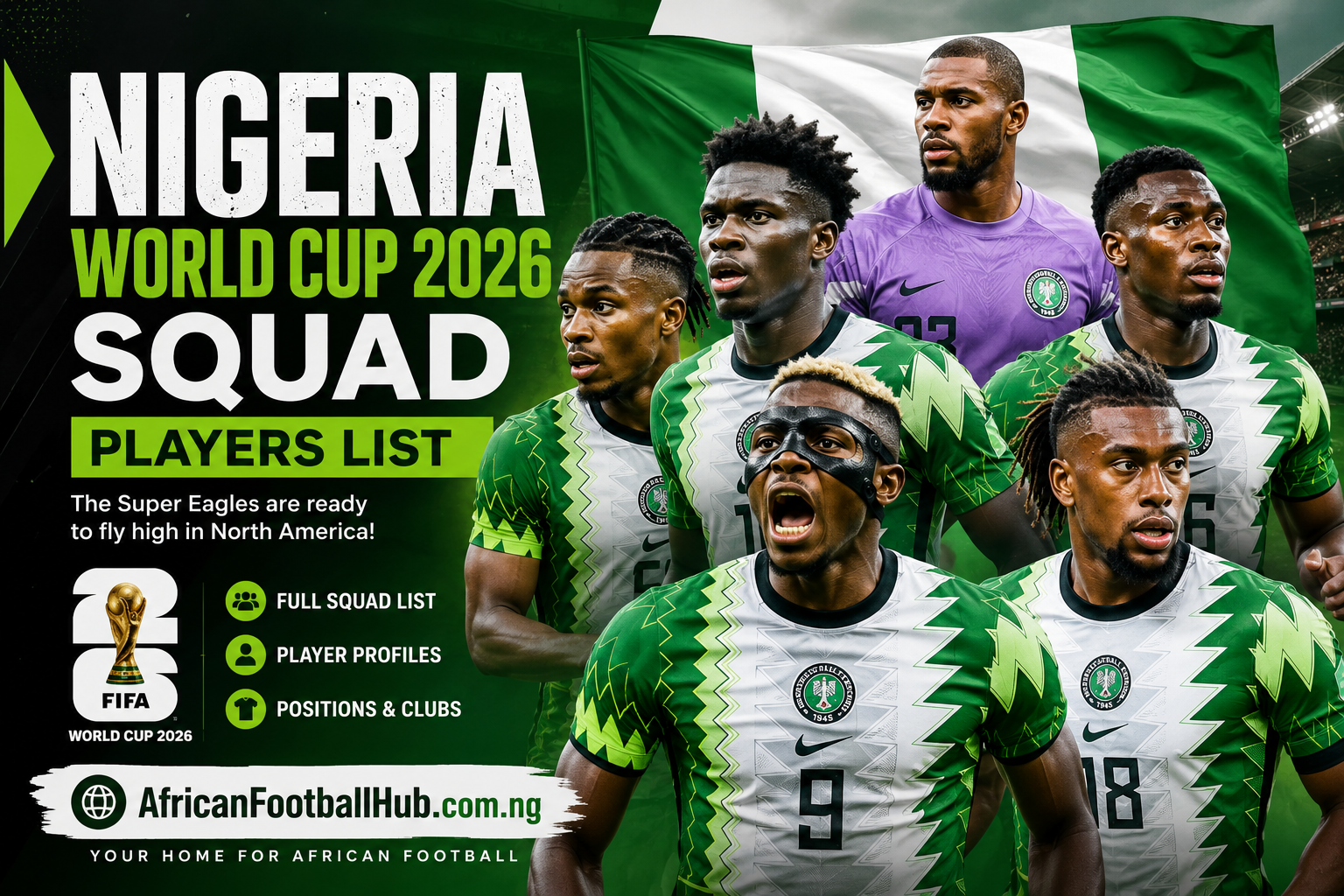
The Nigeria World Cup 2026 squad players list tells a story of talent, frustration and a nation that missed football’s biggest stage for the second time in a row. Despite having one of Africa’s most gifted generations Victor Osimhen, Ademola Lookman, Alex Iwobi, Wilfred Ndidi and more the Super Eagles failed to qualify for the 2026 FIFA World Cup. Here is the full breakdown of the squad used during the campaign, who the key players were, and what went wrong.
The Hard Truth: Nigeria Did Not Qualify for World Cup 2026
Let’s start with the facts, because Nigerian fans deserve honesty.
Nigeria will not be at the 2026 FIFA World Cup in the United States, Canada and Mexico. The Super Eagles failed to qualify — missing consecutive World Cups for the first time since their debut at the 1994 tournament. That is a painful record for a nation that considers itself one of Africa’s elite football powers.
The final blow came in Rabat, Morocco on November 16, 2025. Nigeria drew 1-1 with DR Congo after extra time in the CAF play-off final, then lost 4-3 on penalties. Frank Onyeka gave Nigeria the lead. Meschack Elia equalised. Then Calvin Bassey, Moses Simon and Semi Ajayi all missed from the spot. Substitute goalkeeper Timothy Fayulu saved Ajayi’s penalty in the sixth round to confirm Nigeria’s elimination.
The NFF issued a public apology. Coach Eric Chelle made headlines for the wrong reasons — suggesting DR Congo had used “voodoo” during the shootout, a claim that was widely mocked and seen as a deflection from serious structural failures.
But before we dissect the failure, let’s look at the players who represented Nigeria throughout this campaign.
Nigeria World Cup 2026 Squad: Players Used During Qualifying
Nigeria used multiple squads across their qualifying campaign, which ran from 2023 to November 2025 under three different coaches. Below are the core players who featured most consistently.
Goalkeepers
- Stanley Nwabali — Chippa United (South Africa) | First-choice goalkeeper. His penalty saves in the shootout were not enough to save Nigeria.
- Maduka Okoye — Udinese (Italy) | Experienced deputy with Premier League background.
Defenders
- William Troost-Ekong — Captain. The defensive anchor and leader throughout qualification.
- Calvin Bassey — Fulham (England) | Versatile centre-back who missed a crucial penalty in Rabat.
- Semi Ajayi — West Bromwich Albion (England) | Missed the decisive penalty against DR Congo.
- Ola Aina — Nottingham Forest (England) | Regular first-choice left-back with experience and energy.
- Bright Osayi-Samuel — Fenerbahçe (Turkey) | Attack-minded right-back, a constant threat going forward.
- Zaidu Sanusi — FC Porto (Portugal) | Dependable left-back option throughout the campaign.
- Chidozie Awaziem — Experienced squad defender, provided depth at centre-back.
- Benjamin Fredericks — Emerging full-back, called up during the decisive play-off stages.
Midfielders
- Wilfred Ndidi — Beşiktaş (Turkey) | Nigeria’s midfield engine. Breaks up play, protects the backline, leads by example.
- Alex Iwobi — Fulham (England) | 89+ caps. The most experienced outfield player. Versatile, creative, consistent.
- Frank Onyeka — Brentford (England) | Scored Nigeria’s goal in the play-off final. Combative and energetic in central midfield.
- Raphael Onyedika — Club Brugge (Belgium) | Young, box-to-box midfielder who impressed throughout the campaign.
- Fisayo Dele-Bashiru — Hatayspor (Turkey) | Exciting midfield talent who earned his place in the senior squad.
- Alhassan Yusuf — New England Revolution (USA) | Tireless runner in central midfield, valuable squad option.
Forwards
- Victor Osimhen — Galatasaray (Turkey) | Nigeria’s best player and biggest star. The Super Eagles were a different team without him. Only scored four points from a possible 15 in group stage matches he missed through injury.
- Ademola Lookman — Atalanta / Atlético Madrid | Nigeria’s second most dangerous attacker. Moved to Atlético Madrid in January 2026. Devastating on his day.
- Samuel Chukwueze — Fulham (England) | Pacey, direct winger who could unlock any defence on a good day.
- Moses Simon — Paris FC (France) | Another penalty miss in Rabat. Experienced winger with good dribbling ability.
- Cyriel Dessers — Nigerian-Belgian striker who served as backup to Osimhen.
- Tolu Arokodare — Wolverhampton Wanderers (England) | Rising striker, started making an impression at senior level.
- Akor Adams — Sevilla (Spain) | Another attacking option added as Nigeria sought to fire their way to qualification.
- Chidera Ejuke — Sevilla (Spain) | Pacy winger included in the play-off squad.
Victor Osimhen: The Player Nigeria Built Their World Cup Hopes On
No player defined Nigeria’s qualifying campaign more than Victor Osimhen — even through his absences.
When Osimhen played, Nigeria were dangerous. When he was injured, Nigeria struggled. The Super Eagles collected only four points from a possible 15 in group stage games without him. That is the damning statistic that summarises the campaign.
Osimhen is Nigeria’s greatest attacking talent in a generation. He was playing for Galatasaray when the play-offs came around and had been in fine scoring form in Turkey. But it was not enough. In the final against DR Congo, Nigeria’s attack never really got going. The team lacked the clinical edge to finish the job when the big moment arrived.
At club level, Osimhen remains a world-class striker. He is still only 25 years old. The 2030 World Cup will be a major target.
Ademola Lookman and the Unlocked Potential
Ademola Lookman is the other name that defines this generation of Super Eagles football. The man who scored a hat-trick in the Europa League final for Atalanta. The man who joined Atlético Madrid in January 2026 and immediately made an impact, contributing 13 goals and assists in his first 23 games.
Lookman was electric for Nigeria when fit and available. But the team around him was inconsistent. Nigeria never found a consistent system that maximised both Osimhen and Lookman together at their best. When you have two world-class forwards and still cannot qualify, the problem goes deeper than the front line.
What Went Wrong: Three Coaches, One Campaign
Nigeria’s 2026 World Cup qualifying campaign is one of the most chaotic in the Super Eagles’ history. Three different coaches were in charge during the campaign. That instability is impossible to overcome at international level.
The qualifying group — Group C — contained South Africa, Nigeria, Rwanda, Zimbabwe, Benin Republic and Lesotho. Nigeria should have topped that group. They did not. South Africa finished first. Nigeria scraped through as runners-up on goal difference, which dumped them straight into the CAF play-offs.
Eric Chelle, who replaced Augustine Eguavoen in January 2025, stabilised things. He won four and drew two in his competitive matches in charge. That included beating Gabon in the play-off semi-final. But the DR Congo final proved one step too far.
The structural issues inconsistent player availability, NFF administration problems, late coaching appointments, and a lack of clear tactical identity — remain unresolved. The Nigeria Football Federation issued an apology to the country and to President Bola Tinubu after the elimination. Words. Nigerian fans want action.
The Play-Off Squad: Nigeria’s Final 24 for Rabat
For the CAF play-offs in Morocco, Eric Chelle named a 24-man squad. This was Nigeria’s final attempt to reach the World Cup. Here is that squad in full:
Goalkeepers: Stanley Nwabali, Maduka Okoye
Defenders: William Troost-Ekong, Calvin Bassey, Semi Ajayi, Ola Aina, Bright Osayi-Samuel, Chidozie Awaziem, Benjamin Fredericks
Midfielders: Alex Iwobi, Wilfred Ndidi, Raphael Onyedika, Frank Onyeka, Alhassan Yusuf, Fisayo Dele-Bashiru
Forwards: Victor Osimhen, Ademola Lookman, Samuel Chukwueze, Moses Simon, Akor Adams, Tolu Arokodare, Chidera Ejuke, Olakunle Olusegun
On paper, that is a squad that should have been enough. World Cup-level quality from the first name to the last. But football is not played on paper.
Rising Stars Who Will Target 2030
The Super Eagles will not be at the 2026 World Cup, but Nigerian football is not finished. There is a generation of players who will be targeting the 2030 tournament in Morocco, Portugal and Spain — and some of them have already shown what they are capable of.
- Raphael Onyedika — The Club Brugge midfielder is one of the most complete young players Nigeria has produced in years. He controls games. He scores. He wins the ball. At 23, he could be the cornerstone of the next cycle.
- Fisayo Dele-Bashiru — Athletic, aggressive, technically improving. His brother Tom is also emerging as an international prospect.
- Tolu Arokodare — The Wolves striker brings physicality and pace. If he develops his finishing at the highest level, he becomes a problem for any defence.
- Benjamin Fredericks — The young full-back showed plenty of promise and will only get better with experience.
These players, combined with a peak Victor Osimhen and Ademola Lookman at Atlético Madrid, should mean Nigeria go into 2030 qualifying as serious contenders — if the administration gets its act together.
Nigeria’s World Cup Record: Context Matters
Nigeria have appeared at the World Cup six times: 1994, 1998, 2002, 2010, 2014 and 2018. Their best performance was the round of 16 — reached in 1994, 1998 and 2014.
They missed 2006 and 2010 (as a non-host) and Qatar 2022. Now they miss 2026. Two consecutive absences in a row is a genuine crisis. For a country of over 220 million people, with a massive football-mad diaspora based in the United States — the host nation this time missing this particular tournament is especially painful.
The talent is there. The results are not. That gap needs to close before 2030.
What Happens Next for the Super Eagles
Nigerian football does not stop because the World Cup is happening without them. The Super Eagles have been involved in friendlies, including a match against Portugal in June 2026 — a reminder that the quality is still there, even if the tournament stage is absent this time.
The NFF needs to commit to long-term coaching stability. One coach. One system. One clear identity. Morocco built their success over years under Walid Regragui. Senegal built under Aliou Cissé. Nigeria keeps starting from scratch every 18 months. That must change.
The 2027 AFCON in Kenya, Uganda and Tanzania will be the first major test. Then qualifying begins for 2030. The window to fix Nigerian football is not closed. But it is not wide open either.
Frequently Asked Questions
Did Nigeria qualify for the 2026 World Cup?
No, Nigeria did not qualify for the 2026 FIFA World Cup. The Super Eagles were eliminated in the CAF play-off final, losing to DR Congo 4-3 on penalties after a 1-1 draw after extra time in Rabat, Morocco in November 2025. It is the second consecutive World Cup Nigeria have missed, following their absence from Qatar 2022.
Who were the key players in Nigeria’s World Cup 2026 qualifying squad?
Nigeria’s qualifying campaign was built around striker Victor Osimhen (Galatasaray), winger Ademola Lookman (Atalanta/Atlético Madrid), midfielder Alex Iwobi (Fulham) and defensive midfielder Wilfred Ndidi (Beşiktaş). Captain William Troost-Ekong led the defence, while Stanley Nwabali was first-choice goalkeeper. Despite this quality, the team could not secure qualification.
Why did Nigeria fail to qualify for World Cup 2026?
Nigeria’s failure was caused by a combination of factors: a chaotic qualifying campaign overseen by three different coaches, over-reliance on Victor Osimhen who missed key matches through injury, and a lack of consistent tactical identity. The Super Eagles finished second in their qualifying group behind South Africa, were forced into the CAF play-offs, and lost on penalties to DR Congo in the final.
When will Nigeria next have a chance to qualify for the World Cup?
Nigeria’s next opportunity will be the 2030 FIFA World Cup qualification campaign, which will begin in 2027. The 2030 tournament will be hosted by Morocco, Spain and Portugal. With players like Victor Osimhen, Ademola Lookman and Raphael Onyedika still in their prime, Nigeria will be strong contenders — provided the Nigerian Football Federation provides the stability and long-term planning the team needs.

Samuel Jegede is a passionate football writer and sports enthusiast dedicated to covering African football, World Cup 2026 developments, player profiles, match analysis, and breaking news for fans across Africa and beyond.