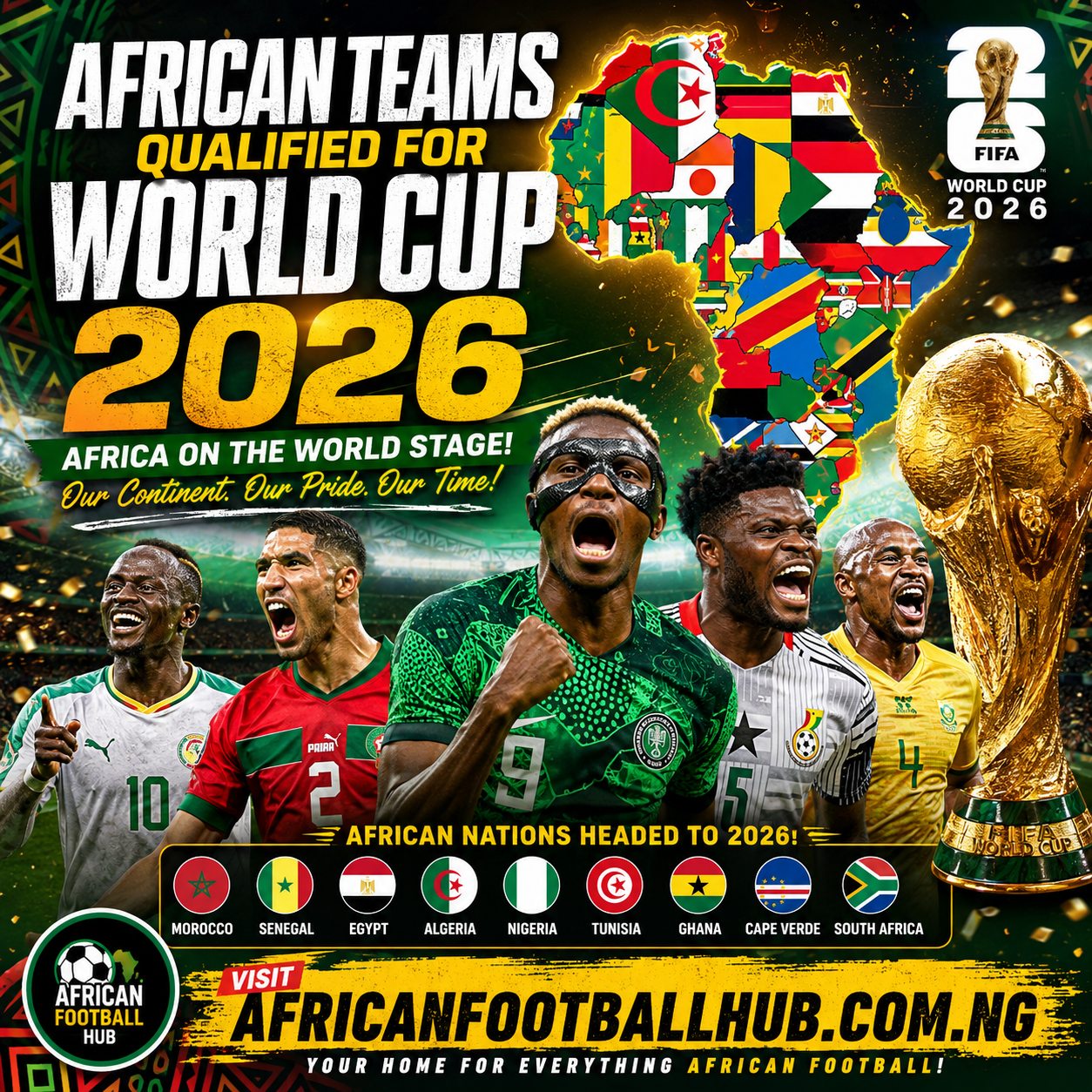
Which African teams qualified for World Cup 2026? The answer is historic: a record 10 CAF nations will represent the continent at the expanded 48-team tournament in the United States, Canada and Mexico. The 10 teams are Morocco, Senegal, Algeria, Tunisia, Egypt, Côte d’Ivoire, Ghana, Cape Verde, South Africa and DR Congo. Read on for the full breakdown how each team qualified, which groups they landed in, and who to watch.
A Record-Breaking Moment for African Football
Africa has never sent this many teams to a World Cup. Ever.
At previous tournaments, CAF was allocated five slots. The expansion of the World Cup from 32 to 48 teams pushed Africa’s allocation up to nine automatic places plus one additional inter-confederation play-off slot. All 10 spots were filled.
DR Congo clinched the final place with a dramatic 1-0 extra-time win over Jamaica in the inter-confederation play-offs an Axel Tuanzebe goal in the 100th minute sealing their historic qualification. It completed a 10-team African contingent that, on paper, is the strongest the continent has ever assembled for a single tournament.
For African football fans — and especially for Nigerian supporters watching from the outside — this is both a celebration and a reminder of what qualification means. Nigeria missed out after losing to DR Congo on penalties in the CAF play-off. The Super Eagles’ absence stings. But the quality of those who made it is undeniable.
The Full List: All 10 African Teams at World Cup 2026
Here are all 10 CAF nations confirmed for the 2026 FIFA World Cup in North America:
- Morocco — topped CAF Group G; Africa’s highest-ranked team
- Senegal — won their qualifying group unbeaten; fourth World Cup appearance
- Egypt — won CAF Group A; the Mohamed Salah era finally reaches a World Cup
- Algeria — strong qualifiers; a dangerous side built around Bruno Génésio’s system
- Côte d’Ivoire — won CAF Group F; AFCON 2024 champions
- Tunisia — won CAF Group H; chasing a first-ever knockout stage appearance
- Ghana — returned to the finals after missing 2018; placed in Pot 4 at the draw
- Cape Verde — won CAF Group B; the tournament’s feel-good underdogs
- South Africa — won CAF Group C; first World Cup since hosting in 2010
- DR Congo — inter-confederation play-off winners; returning for the first time since 1974
How the CAF Qualification Process Worked
The road to World Cup 2026 for African teams was structured, tough and sometimes cruel.
CAF’s 54 member nations were drawn into nine groups. The group winner from each group qualified automatically — that accounts for nine of the ten African spots. The four best runners-up from across the groups went into a play-off semi-final round, with the two play-off winners meeting in a final. The CAF play-off winner then entered the FIFA inter-confederation play-offs against teams from other confederations for the 10th and final African berth.
DR Congo navigated that entire play-off path. They beat Nigeria 4-3 on penalties after a 1-1 draw in the CAF play-off final, then defeated Jamaica 1-0 in extra time at the inter-confederation stage. Two knock-out rounds. Both survived.
Notable casualties: Cameroon — who suffered a shock defeat to DR Congo in the play-off semi-finals — and Nigeria, who went out on penalties. Both are sleeping giants who will be absent in North America.
World Cup 2026 Groups: Where Do the African Teams Land?
The draw placed African teams in varying levels of difficulty. Here is a snapshot of what each team faces:
- Morocco (Group C) — face Brazil, Scotland and Haiti. A blockbuster opener against the Seleção on June 13. The Atlas Lions will fancy their chances of progressing if they get past the Scotland fixture.
- Senegal (Group B) — drawn against France and Norway. Tough group. Sadio Mané’s side cannot afford to switch off for a single match.
- Egypt — paired with Belgium, Iran and New Zealand. The most forgiving draw of any African team. If Salah is fit, Egypt could realistically reach the round of 16.
- Algeria — face Argentina. A mouth-watering match-up that will draw huge interest across North Africa.
- Côte d’Ivoire — matched with Germany and Ecuador. A step up in class, but the Elephants have the squad depth to compete.
- South Africa — opening the entire 2026 World Cup against co-hosts Mexico. Bafana Bafana will be in the global spotlight from day one.
- Tunisia, Ghana, Cape Verde, DR Congo — all face challenging groups but have real motivation and the platform of the biggest stage in football.
Morocco and Senegal entered the draw in Pot 2 — the first time African teams have been placed that high at a World Cup draw. That is not an accident. It is a direct result of rising FIFA rankings and the growing respect for African football after Morocco’s sensational semi-final run at Qatar 2022.
Morocco: Africa’s Flag-Bearer
When you ask which African team goes into World Cup 2026 with the highest expectations, the answer is Morocco.
The Atlas Lions were the story of Qatar 2022 — the first African team ever to reach a World Cup semi-final. They beat Spain and Portugal on the way. That is not a fluke. That is a generation of world-class players, a disciplined defensive structure and a management setup that took years to build.
Morocco won all eight of their CAF qualifying games, scoring 22 goals and conceding just two. They arrive in North America under new head coach Mohamed Ouahbi but with the same core of players who made history four years ago. Achraf Hakimi, Hakim Ziyech, Youssef En-Nesyri — the talent is still there.
Africa will be watching Morocco closely. If they go deep again, it changes the conversation around African football for a generation.
Senegal and Egypt: The Other Heavyweights
Senegal come in as African champions — they won AFCON 2022 in Cameroon and reached a fourth World Cup without losing a qualifying match. Sadio Mané remains the talisman. At 34, this may be his final World Cup, and he will be desperate to make it count.
Egypt are finally at a World Cup with Mohamed Salah in his prime. The last time Egypt qualified Russia 2018 the Pharaohs went out in the group stage without a win. This time, Salah is a Champions League and Premier League veteran. The hunger will be different.
Algeria, with their fearless pressing style, could be the dark horses nobody wants to face. They have quality all over the pitch and a fanbase — in Algeria and across Europe — that travels in massive numbers.
The Underdogs: Cape Verde, South Africa and DR Congo
Do not sleep on the smaller stories.
Cape Verde are making their debut at a senior World Cup. The Blue Sharks, from an island nation of fewer than 600,000 people, qualified ahead of far bigger football nations. They play with fearlessness. They have nothing to lose and everything to prove.
South Africa are back on the global stage after 16 years away. Coach Hugo Broos built a team with identity and resilience they even finished third at AFCON 2023. The opening match against Mexico on home soil for the tournament carries enormous emotional weight for the South African football community.
DR Congo’s qualification story might be the most dramatic of all. Back at the World Cup for the first time since 1974 — that is 52 years. An entire generation of Congolese fans have never seen their national team at football’s biggest event. When that final whistle blew against Jamaica, it was not just a football result. It was a moment.
What This Means for African Football
Ten teams. Double-digit representation for the first time in history.
It is not just about the number. It is about what those teams represent. Morocco proved Africa can reach the last four. Senegal showed that African champions are world-class champions. Egypt demonstrated that elite individual talent, finally at a World Cup in its best form, is a genuine threat.
The 2026 World Cup is genuinely Africa’s best chance to make the deepest collective impact the continent has ever had at a single tournament. Multiple African teams reaching the round of 16 is not a fantasy it is a realistic target.
For Nigerian fans who will be watching at home rather than representing the continent, the challenge is clear. The Super Eagles need to look at DR Congo’s journey — two play-off rounds, penalties, extra time and understand what qualification requires. The motivation to return to the World Cup in 2030 starts now.
Frequently Asked Questions
Which African teams qualified for World Cup 2026?
A record 10 African teams qualified for the 2026 FIFA World Cup: Morocco, Senegal, Egypt, Algeria, Côte d’Ivoire, Tunisia, Ghana, Cape Verde, South Africa and DR Congo. Nine teams qualified automatically as group winners in CAF qualifying, while DR Congo secured the 10th spot via the inter-confederation play-offs.
How many African teams are at the 2026 World Cup?
Ten African teams the most ever from the continent at a single World Cup. This is a historic milestone made possible by FIFA’s expansion of the tournament from 32 to 48 teams, which increased Africa’s allocation from five to nine automatic slots plus one inter-confederation play-off place.
Did Nigeria qualify for the 2026 World Cup?
No. Nigeria did not qualify for the 2026 FIFA World Cup. The Super Eagles finished as runners-up in CAF Group C behind South Africa and reached the CAF play-off final, where they lost to DR Congo 4-3 on penalties after a 1-1 draw. Cameroon also missed out after being eliminated by DR Congo in the semi-finals.
Which African team is the favourite at World Cup 2026?
Morocco are widely regarded as Africa’s strongest side heading into the 2026 World Cup, after reaching the semi-finals at Qatar 2022 — the best-ever finish by an African nation. Senegal, as African champions and a Pot 2 team, are also considered strong contenders. Egypt, with Mohamed Salah in their squad, could surprise many in their group.

Samuel Jegede is a passionate football writer and sports enthusiast dedicated to covering African football, World Cup 2026 developments, player profiles, match analysis, and breaking news for fans across Africa and beyond.