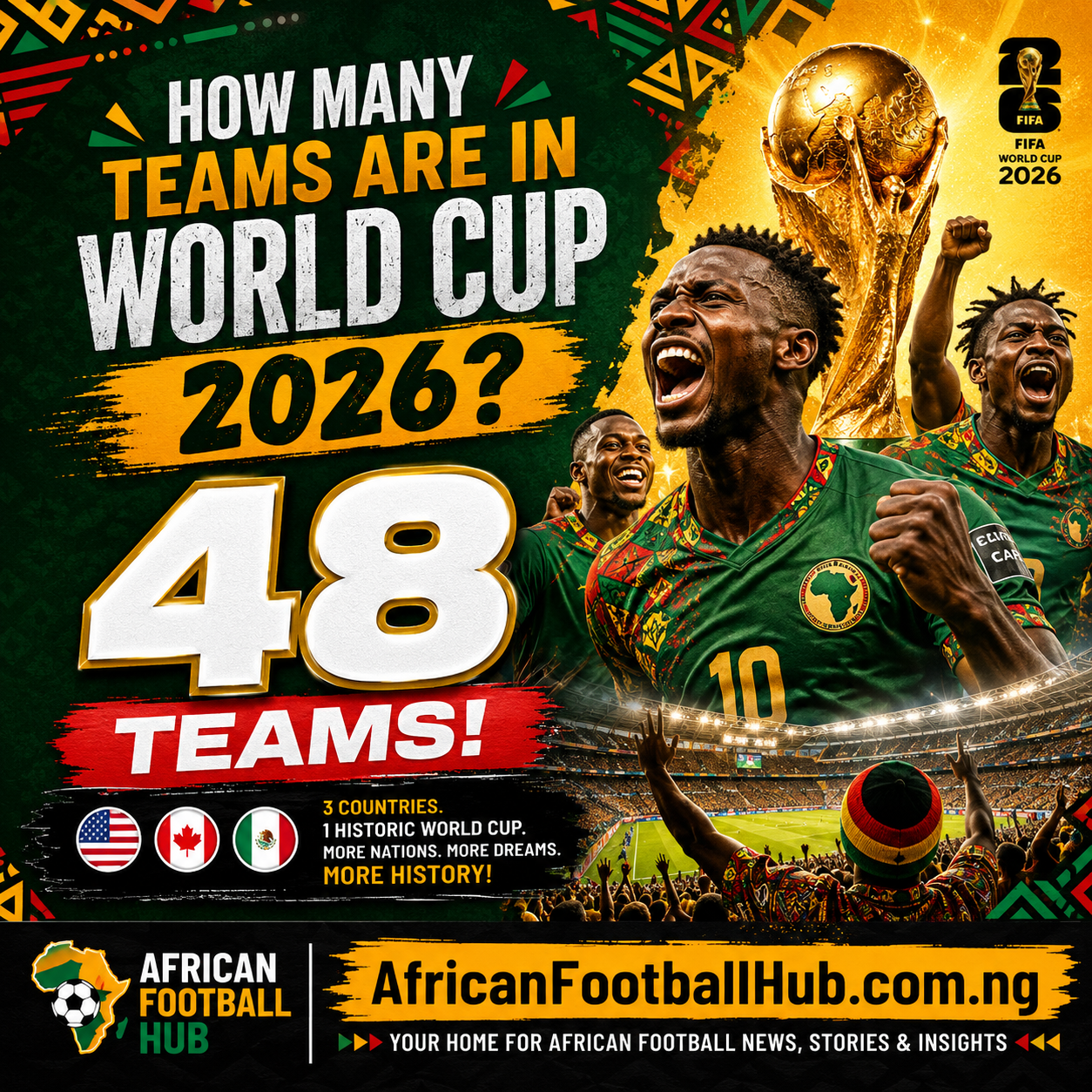
How many teams are in World Cup 2026? The answer is 48 teams — the biggest expansion in the tournament’s history. FIFA made the call back in 2017, and come June 2026, the United States, Canada, and Mexico will host a World Cup unlike anything football has ever seen. More teams. More matches. More drama. And crucially for us on this side of the world, more African nations than ever before. Here is everything you need to know about the new format, who qualifies, and what it means for African football.
Why Did FIFA Expand the World Cup to 48 Teams?
For decades, the World Cup ran with 32 teams — a format that worked well but left too many deserving nations on the outside looking in. Asia, Africa, and the Americas all had genuine footballing talent that the old quota system simply could not accommodate.
FIFA President Gianni Infantino pushed the expansion hard, and the argument was straightforward: more inclusion, more commercial revenue, more global reach. The 48-team format was officially approved by FIFA’s Council in January 2017. The numbers made sense politically and financially. A larger tournament means more broadcast deals, more sponsorship, and more eyes on the game from regions that had long felt underrepresented.
Critics worried that the group stage would be diluted — weaker teams padding out the tournament. But the structure FIFA designed deals with that concern in an interesting way. More on that below.
How Does the 48-Team Format Actually Work?
The new format is built around 12 groups of four teams. That replaces the old eight groups of four. Each team plays three group-stage matches. The top two from each group advance automatically — that gives you 24 qualified teams. Then the eight best third-placed teams from across all 12 groups also go through, bringing the knockout-round total to 32 teams.
From there, it is a straight knockout: Round of 32, Round of 16, Quarter-finals, Semi-finals, and the Final.
The total number of matches jumps from 64 to 104 matches across the tournament. That is a significant increase, which is why three host countries were needed to provide the stadium infrastructure.
Tournament Breakdown at a Glance
- Total teams: 48
- Group stage groups: 12 (four teams each)
- Teams qualifying from groups: 32 (top two per group + eight best third-placed)
- Knockout rounds: Round of 32 → Round of 16 → Quarter-finals → Semi-finals → Final
- Total matches: 104
- Host nations: USA, Canada, Mexico
How Many Teams Does Africa (CAF) Get?
This is where African football fans have every reason to be excited. Under the old 32-team format, CAF received five spots. In the 48-team World Cup 2026, Africa’s allocation jumps to nine spots. That is nearly double.
Nine African nations at a single World Cup. Think about that. It means the continent’s best teams — Nigeria, Senegal, Morocco, Egypt, Ivory Coast, Cameroon, Ghana, and more — now have a much more realistic path to qualification. In any given cycle, the AFCON-calibre nations that used to miss out on narrow playoff defeats now have room to breathe.
CAF has structured its qualification through the African qualifiers, which run across several rounds. The top nine nations from the final qualifying round earn their World Cup berths automatically. There is also a possibility of an intercontinental playoff spot that could give a 10th African nation a chance, depending on the draw.
For Nigeria specifically the Super Eagles this expanded quota is a significant opportunity. The Eagles have the quality to qualify comfortably when given the chances, and nine spots makes the maths considerably more forgiving.
Full Confederation Allocation: All 48 Spots Explained
FIFA distributes the 48 places across its six confederations. Here is the confirmed breakdown:
| Confederation | Region | Spots |
|---|---|---|
| CAF | Africa | 9 (+1 possible playoff) |
| UEFA | Europe | 16 |
| CONMEBOL | South America | 6 (+1 possible playoff) |
| AFC | Asia | 8 (+1 possible playoff) |
| CONCACAF | North/Central America & Caribbean | 6 (+1 possible playoff) * |
| OFC | Oceania | 1 (+1 possible playoff) |
* USA, Canada, and Mexico qualify automatically as host nations. Their spots are counted within the CONCACAF allocation.
In addition, two intercontinental playoff spots are available, where teams from different confederations meet in a mini-tournament to compete for the final World Cup places. The exact playoff draw format is managed by FIFA closer to the qualifying conclusion.
Europe remains the largest bloc with 16 teams understandable given UEFA’s size and competitive depth. But Africa’s nine spots represent a clear acknowledgement that the continent’s football has grown far beyond what five slots could represent.
Where Will the 2026 World Cup Be Played?
The tournament is spread across three countries and 16 host cities:
- United States: New York/New Jersey, Los Angeles, Dallas, San Francisco, Seattle, Boston, Miami, Atlanta, Kansas City, Philadelphia
- Canada: Toronto, Vancouver
- Mexico: Mexico City, Guadalajara, Monterrey
The Final will be played at MetLife Stadium in East Rutherford, New Jersey — home of the NFL’s New York Giants and Jets, with a capacity of over 82,000. It is one of the largest stadiums in the world and a fitting stage for the biggest match in football.
Distances between host cities will be significant — some matches will require flights of several hours within the same tournament. It is a genuinely vast operation, and logistics will be a talking point throughout.
What Does This Mean for African Football Fans?
Simply put: this World Cup was built with broader representation in mind, and Africa benefits more than almost any other confederation on a percentage basis.
Nine teams from 54 CAF member nations means the qualifying campaign is fierce and competitive. Nations like Morocco who reached the semi-finals at Qatar 2022 are genuine contenders. Senegal bring AFCON pedigree and Premier League firepower. Nigeria have the potential to go deep if they click. Egypt have Salah. Ivory Coast and Cameroon are never to be underestimated.
For the first time, it is genuinely possible to imagine multiple African teams reaching the knockout stages simultaneously. With nine entrants in the group stage, the probability of at least two or three progressing to the Round of 32 is high especially given the eight best third-placed teams also advance.
African football has been building. The infrastructure, the academies, the European-based players returning to represent their nations all of it has been moving in one direction. World Cup 2026, with its expanded 48-team format, arrives at exactly the right moment for the continent.
Key Dates for World Cup 2026
- Tournament Start: 11 June 2026
- Group Stage Concludes: Late June 2026
- Round of 32 & Round of 16: Early to mid July 2026
- Quarter-finals: 4–5 July 2026
- Semi-finals: 14–15 July 2026
- Third-Place Match: 18 July 2026
- Final: 19 July 2026 — MetLife Stadium, New Jersey
Quick Facts: World Cup 2026 vs Previous Tournaments
| Detail | Qatar 2022 | World Cup 2026 |
|---|---|---|
| Total Teams | 32 | 48 |
| Total Matches | 64 | 104 |
| African Teams | 5 | 9 |
| Groups | 8 | 12 |
| Host Countries | 1 | 3 |
| First Knockout Round | Round of 16 | Round of 32 |
Frequently Asked Questions
How many teams are in World Cup 2026?
World Cup 2026 will feature 48 teams up from the 32 that competed at Qatar 2022. It is the largest expansion in the history of the FIFA World Cup, driven by FIFA’s push for greater global inclusion and increased commercial reach across more regions.
How many African teams will be at World Cup 2026?
Africa (CAF) has been allocated nine guaranteed spots at World Cup 2026, with a potential 10th place available through an intercontinental playoff. This is nearly double the five spots African nations received at previous 32-team tournaments, making it the most significant quota increase for the continent in World Cup history.
Has the World Cup format changed for 2026?
Yes, significantly. The tournament moves from 8 groups of four teams to 12 groups of four teams. The top two in each group automatically advance, plus the eight best third-placed teams giving a Round of 32 as the first knockout stage. The total match count rises from 64 to 104.
Where is the World Cup 2026 Final being held?
The Final is scheduled for 19 July 2026 at MetLife Stadium in East Rutherford, New Jersey, USA. The stadium holds over 82,000 spectators and is one of the largest in the world, making it a fitting venue for what promises to be the most-watched sporting event on the planet.

Samuel Jegede is a passionate football writer and sports enthusiast dedicated to covering African football, World Cup 2026 developments, player profiles, match analysis, and breaking news for fans across Africa and beyond.