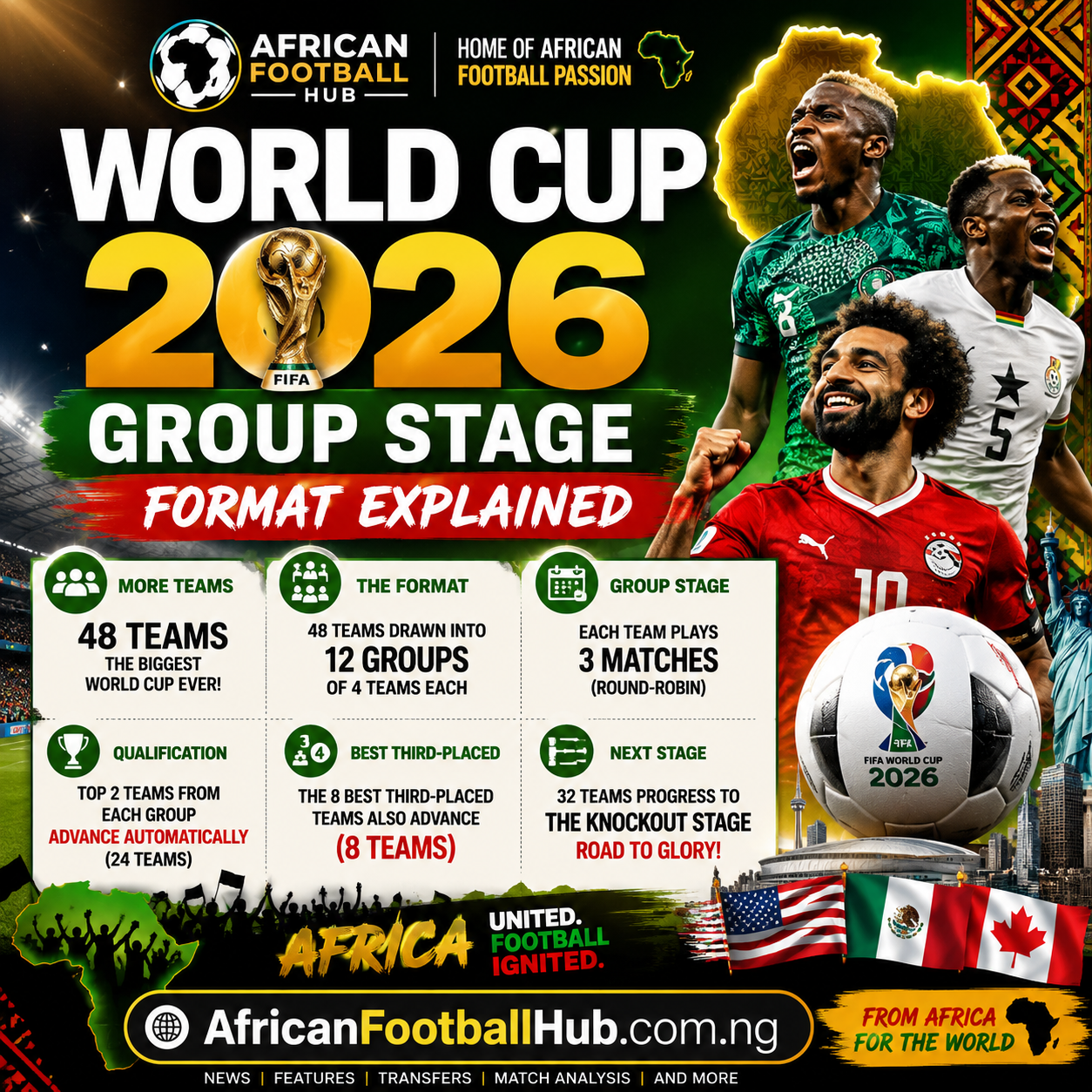
The World Cup 2026 group stage format explained in one line: 48 teams, 12 groups of four, and 32 spots in the knockout rounds. This is the biggest structural change to the World Cup in nearly 30 years, and it matters hugely for African football. Nine CAF nations are heading to North America, and understanding how the group stage works could be the difference between following your team with confidence or getting lost in the new setup. Let’s break it all down clearly and completely.
Why FIFA Changed the World Cup Format for 2026
Since France 1998, the World Cup ran on the same blueprint: 32 teams, 8 groups of four, 64 total matches. It worked. But FIFA, under President Gianni Infantino, pushed hard to expand the tournament to reflect the full global reach of football.
The result? A 48-team World Cup hosted across the United States, Canada, and Mexico — the first time three nations have co-hosted the tournament.
The expansion means:
- 48 teams competing — up from 32 (a 50% increase)
- 104 total matches — up from 64
- 9 African nations qualified automatically via CAF, up from 5
- More football, more upsets, more chances for smaller nations to make history
For the African continent, this expansion is massive. CAF went from five guaranteed spots to nine — meaning more Super Eagles, more AFCON winners, more African stars on the world stage.
The New Group Stage Structure: 12 Groups of Four
Here is how the group stage works in 2026:
All 48 qualified teams are divided into 12 groups — Groups A through L. Each group contains exactly four teams. Every team plays the other three teams in their group once, meaning each nation plays three group matches.
That gives us 72 group-stage matches in total — up from the 48 played at previous 32-team tournaments.
FIFA initially floated the idea of 16 groups of three teams. They dropped that plan, and wisely so. Three-team groups created serious risks of collusion in the final matchday — two teams could play out a convenient draw to both advance. The four-team format protects competitive integrity and guarantees every team plays at least three matches.
How the Groups Were Seeded
The FIFA draw divided all 48 qualified teams into four seeding pots based on FIFA World Rankings. One team from each pot was placed into each group. This system prevents the strongest teams from clustering together and ensures a mix of established powers and rising nations in every group.
No group can contain more than two European teams, keeping the competition balanced across confederations.
How Teams Advance: The Round of 32
This is where the new format differs most from what fans are used to. Instead of 16 teams advancing from the group stage, 32 teams move into the knockout rounds.
Here is who qualifies from the group stage:
- Top two teams from each of the 12 groups — that is 24 teams automatically through
- The 8 best third-placed teams from across all 12 groups — selected based on overall performance
That means 32 teams total enter the knockout bracket — a Round of 32, then Round of 16, quarter-finals, semi-finals, and the final.
This is crucial for African teams. Even finishing third in a competitive group does not end your World Cup. If you pick up enough points and your goal difference is decent, you can still advance. A team with one win and two draws in third place could realistically qualify. That is a genuine safety net that did not exist before.
Points System and Tiebreakers
The points system stays the same as always:
- Win = 3 points
- Draw = 1 point
- Loss = 0 points
But what happens when teams are level on points? FIFA uses a series of tiebreakers, applied in this order:
- Goal difference — goals scored minus goals conceded in all group matches
- Goals scored — the team with more goals ranks higher
- Head-to-head record — points, goal difference, and goals scored in matches between the tied teams specifically
- Fair play ranking — fewer yellow and red cards earns a higher position
- Drawing of lots — only used as a last resort if everything else is equal
For African teams, this tiebreaker order has a practical lesson: score goals, keep cards low, and never cruise when you can push for an extra goal. Every detail counts in a tight group.
How the Best Third-Placed Teams Are Ranked
This element confuses many fans. Here is how it works.
After all 12 groups finish their matches, FIFA takes all 12 third-placed teams and compares them. The 8 with the best records — judged by points first, then goal difference, then goals scored — qualify for the Round of 32.
The four lowest-ranked third-placed teams go home.
The ranking uses only the teams’ records from their three group matches (not head-to-head within the groups). This creates a fair, like-for-like comparison across all groups.
What this means practically: if an African nation finishes third in a tough group — say, behind a South American giant and a strong European side — they still have a realistic path through if they have been competitive in those games. Three points from a group stage is no longer an automatic exit ticket.
African Teams at World Cup 2026: Who Qualified
Nine African nations earned automatic qualification for the 2026 World Cup — the most Africa has ever sent to a single World Cup:
- 🇲🇦 Morocco
- 🇸🇳 Senegal
- 🇨🇮 Ivory Coast
- 🇪🇬 Egypt
- 🇬🇭 Ghana
- 🇹🇳 Tunisia
- 🇩🇿 Algeria
- 🇿🇦 South Africa
- 🇨🇻 Cape Verde
Nigeria, unfortunately, did not make it after losing to DR Congo on penalties in the CAF playoff final. It is a painful absence for Nigerian fans — but it makes the stakes for these nine teams even higher. They carry African football’s hopes in North America.
Morocco, the 2022 semi-finalists, arrive as Africa’s strongest hope to go deep. Senegal, Ivory Coast, and Egypt all have the squad quality to survive the group stage and make noise in the knockouts. With the Round of 32 format offering a third-place lifeline, Africa has never had a better structural chance to send multiple teams into the knockout rounds.
The Knockout Stage: What Happens After the Groups
Once the 32 teams are confirmed from the group stage, the tournament shifts into a straight knockout format. There is no second chance from here — one loss and you go home.
The bracket runs like this:
- Round of 32 — 32 teams, 16 matches
- Round of 16 — 16 teams, 8 matches
- Quarter-finals — 8 teams, 4 matches
- Semi-finals — 4 teams, 2 matches
- Third-place play-off — 1 match
- Final — 1 match
In knockout matches, a draw after 90 minutes leads to 30 minutes of extra time. If still level, it goes to a penalty shootout. No away goals rule — just straight extra time and penalties.
The expanded format means two additional rounds compared to a standard knockout from 16. A team that wins the World Cup in 2026 will have played seven matches — one more than in previous editions.
What the New Format Means for Fans Watching From Africa
For Nigerian fans and supporters across the continent, a few things are worth knowing before the tournament kicks off:
More matches to watch. 104 games across roughly five weeks. There will be overlapping fixtures, especially in the group stage. FIFA has fixed time slots to help broadcasters, but some clashes are unavoidable.
The group stage matters more. Because eight third-placed teams advance, group standings are calculated across multiple groups. A goal you score in the final group game might be the difference between your team qualifying as a best third or going home — even if that goal feels meaningless at the time. Every result is watched.
More continental representation. With nine African teams, at least some African football will be present in every round of the tournament. That has never happened before at a World Cup.
The schedule is spread across three countries. Matches will be played in the USA, Canada, and Mexico. Teams travel significant distances between venues. Fatigue and fixture scheduling will play a bigger role in 2026 than at any previous tournament.
Frequently Asked Questions
How many teams are in the 2026 World Cup group stage?
The 2026 World Cup group stage features 48 teams divided into 12 groups of four. This is an increase from the 32 teams across 8 groups used at every World Cup from 1998 to 2022. Each team plays three group matches before the knockout rounds begin.
How many teams qualify from each group at World Cup 2026?
The top two teams from each of the 12 groups qualify automatically for the Round of 32. In addition, the 8 best-performing third-placed teams from across all 12 groups also advance, bringing the total to 32 teams in the knockout stage.
How are the best third-placed teams decided at World Cup 2026?
All 12 third-placed teams are ranked together based on their group stage record: points first, then goal difference, then goals scored. The 8 teams with the best records advance to the Round of 32; the remaining 4 third-placed teams are eliminated. Fair play points can also be used if teams are still level.
How many African teams are at the 2026 World Cup?
Nine African teams qualified for the 2026 World Cup through CAF qualification: Morocco, Senegal, Ivory Coast, Egypt, Ghana, Tunisia, Algeria, South Africa, and Cape Verde. This is the highest number of African nations ever at a single World Cup tournament, up from five at the 2022 edition in Qatar.

Samuel Jegede is a passionate football writer and sports enthusiast dedicated to covering African football, World Cup 2026 developments, player profiles, match analysis, and breaking news for fans across Africa and beyond.