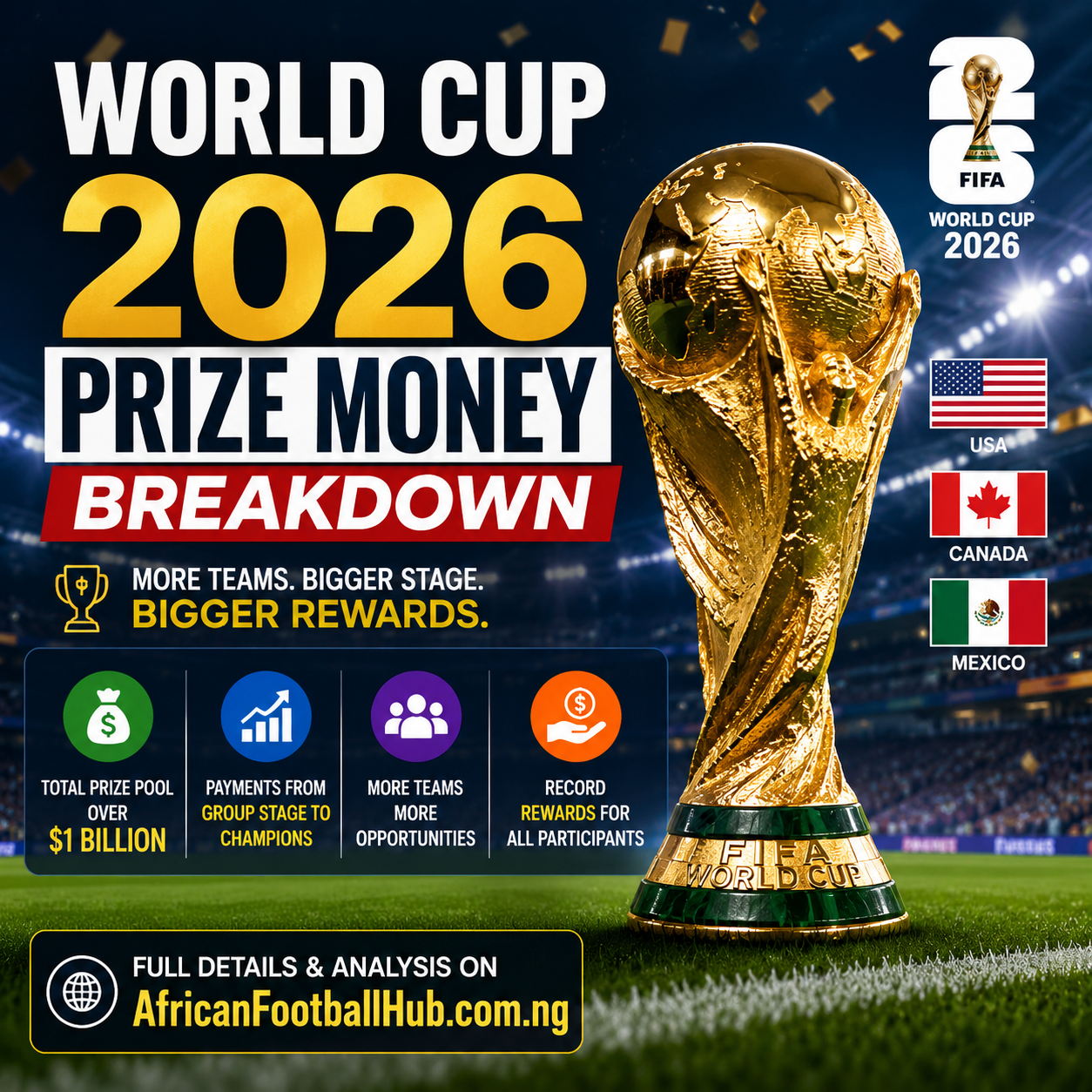
The World Cup 2026 prize money breakdown is genuinely jaw-dropping. FIFA has put a record $655 million on the table for the 48 teams heading to the United States, Canada, and Mexico. The champions walk away with $50 million. Even the teams that go out in the group stage collect $9 million. This is the most financially rewarding World Cup in history and for African nations, who now get nine guaranteed spots, the stakes could not be higher.
How Much Is the Total World Cup 2026 Prize Pool?
FIFA has confirmed a total direct prize money pool of $655 million for World Cup 2026. That is a staggering 49 percent increase on the $440 million distributed at Qatar 2022. In raw numbers, that is an extra $215 million injected into the game.
But here is the thing — the direct prize money is only part of the financial picture. FIFA approved a broader $727 million financial contribution package that includes preparation grants and other support payments to participating federations. So the total money flowing into national football associations because of World Cup 2026 goes well beyond what is listed on the tournament prize table alone.
FIFA President Gianni Infantino described the tournament as a landmark event for football’s financial ecosystem. The numbers back that claim up. No other sporting event in the world distributes prize money at this scale across this many nations.
World Cup 2026 Prize Money – Stage by Stage
Here is the confirmed payout for every finishing position at World Cup 2026. Every single team, regardless of how they perform, walks away with real money.
| Stage / Finish | Prize Money (USD) |
|---|---|
| Champion (1st place) | $50 million |
| Runner-up (2nd place) | $33 million |
| 3rd place | $29 million |
| 4th place | $27 million |
| Quarter-finalists (5th–8th place) | $19 million each |
| Round of 16 exits (9th–16th place) | $15 million each |
| Round of 32 exits (17th–32nd place) | $11 million each |
| Group stage exits (33rd–48th place) | $9 million each |
Every team also receives a $1.5 million preparation grant from FIFA before the tournament begins — on top of their prize money. That means even the 16 teams that go home after the group stage collect a minimum of $10.5 million in total.
How Does This Compare to Qatar 2022?
The jump from 2022 to 2026 is substantial at every level of the prize ladder. Here is a direct comparison:
| Finish | Qatar 2022 | World Cup 2026 | Increase |
|---|---|---|---|
| Champions | $42 million | $50 million | +$8 million |
| Runner-up | $30 million | $33 million | +$3 million |
| 3rd place | $27 million | $29 million | +$2 million |
| Quarter-finalists | $25 million | $19 million | * |
| Group stage exits | $9 million | $9 million | Stable |
* The quarter-final figure looks lower in 2026 because the new Round of 32 stage redistributes some prize money earlier in the knockout process. More teams earn more money overall — the distribution is simply spread across more rounds than before.
The headline takeaway: Argentina received $42 million for winning in Qatar. The winners in New Jersey in July 2026 will collect $50 million — $8 million more for the same trophy.
What Does the New Round of 32 Mean for Prize Money?
The 48-team format introduces a brand new knockout stage — the Round of 32 — that did not exist at any previous World Cup. This matters financially.
Under the old format, teams eliminated in the group stage went home with $9 million. That remains the same. But the new Round of 32 means there is now an extra prize tier between the group stage and the Round of 16. Teams that advance from their groups but exit in the Round of 32 earn $11 million — $2 million more than they would have received for a group stage exit.
For African nations, this is significant. Nine African teams will be at the tournament. In previous World Cups, some genuinely competitive African sides made it through the group stage only to face European giants in a Round of 16 ambush. Now, a Round of 32 win means a Round of 16 place — and $15 million guaranteed. That is life-changing money for football development on the continent.
Who Receives the Money — Players or Federations?
This is one of the most important questions African football fans should be asking — and the answer is not always straightforward.
FIFA pays the prize money directly to the national federation, not to individual players. The federation then decides how to distribute funds internally. There is no universal rule. Every country handles it differently.
Broadly, national federations tend to use World Cup prize money in three ways:
- Player and staff bonuses: A portion — typically anywhere from 30 to 50 percent — is shared with the playing squad and technical staff as performance-based bonuses.
- Federation operations: Administrative costs, staff salaries, and football governance expenses are covered from the fund.
- Football development: Infrastructure, youth academies, grassroots programmes, and facility improvements are funded by the remainder.
For Nigerian football fans, the bonus question is particularly relevant. The NFF has had well-documented disputes with Super Eagles players over bonuses and allowances across multiple tournaments. With $9 million guaranteed even for a group stage exit — and potentially far more if the Eagles progress — getting the bonus structure agreed and communicated clearly before the tournament starts is crucial.
Players do not earn a salary from FIFA for playing at the World Cup. Any money they receive comes via their federation’s internal bonus arrangement. Sponsorship deals and improved marketability are the individual player’s real financial gain from a strong World Cup showing.
What About Club Compensation?
Clubs also receive money from FIFA for releasing players to the World Cup. FIFA has set aside a club compensation fund — with reports indicating over $350 million is ring-fenced for clubs whose players appear at the tournament.
The more minutes a player clocks in the tournament, the more their club earns. For Premier League clubs with Nigerian, Ghanaian, Senegalese, or Moroccan internationals — this is another revenue stream on top of the prize money flowing to national federations.
It means that a player like Victor Osimhen or Ademola Lookman making a deep run at World Cup 2026 benefits their federation, benefits their club, and dramatically boosts their own commercial value — even without a direct FIFA payment landing in their account.
What Does This Mean for African Football?
Let us put this in clear terms. Nine African teams at World Cup 2026. Even if all nine exit in the group stage — the absolute worst-case scenario — African football collectively collects a minimum of $81 million in direct prize money, plus $13.5 million in preparation grants. That is nearly $95 million guaranteed for Africa before a single knockout match is played.
The realistic expectation is much better. Morocco proved in Qatar that African teams can reach the semi-finals. Senegal, Nigeria, Ivory Coast, and Egypt all carry genuine knockout quality. If even four or five African teams reach the Round of 32 — collecting $11 million each the continent’s total payout climbs significantly higher.
For smaller African football nations that qualify, the minimum $10.5 million (prize money plus preparation grant) represents budgets that can transform youth development programmes, build training facilities, and pay coaching staff for years. The financial ripple effect of a World Cup qualification goes well beyond what the table of prize money figures might suggest.
African football is at an inflection point. World Cup 2026 with its record prize money and nine guaranteed African spots arrives at exactly the right moment.
Frequently Asked Questions
How much prize money does the World Cup 2026 winner get?
The winner of World Cup 2026 receives $50 million in prize money from FIFA. That is $8 million more than Argentina earned for winning the 2022 World Cup in Qatar. The money is paid to the victorious national federation, which then distributes a portion to players and staff as bonuses.
How much does a team get for being eliminated in the group stage at World Cup 2026?
Teams that exit in the group stage of World Cup 2026 receive $9 million in prize money, plus a $1.5 million preparation grant — giving a minimum total payout of $10.5 million. With nine African teams at the tournament, even a collective group stage exit guarantees the continent close to $95 million in combined prize money and grants.
Is the World Cup 2026 prize money an increase from 2022?
Yes — significantly. The total prize pool jumps from $440 million at Qatar 2022 to $655 million at World Cup 2026, a near 50 percent increase. FIFA also approved a broader $727 million financial contribution package including preparation grants, meaning the total money flowing to federations is even higher than the headline prize figure.
Do World Cup players receive the prize money directly from FIFA?
No. FIFA pays all prize money directly to the national federation, not to individual players. Each federation then decides how to distribute funds — typically splitting a portion as player and staff bonuses while using the remainder for federation operations and football development. Players generally receive between 30 and 50 percent of their federation’s total prize allocation, depending on the country’s internal agreement.

Samuel Jegede is a passionate football writer and sports enthusiast dedicated to covering African football, World Cup 2026 developments, player profiles, match analysis, and breaking news for fans across Africa and beyond.