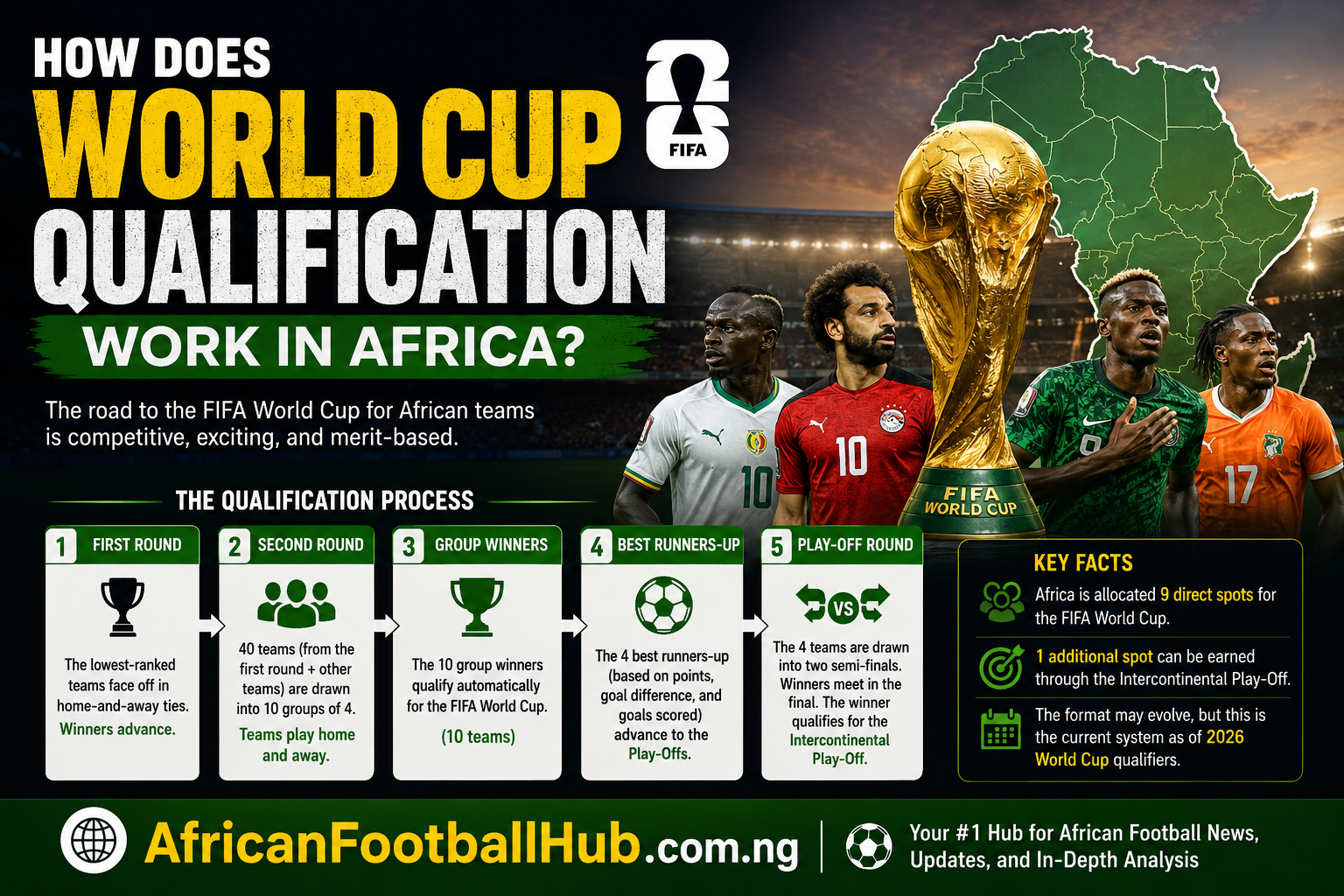
How does World Cup qualification work in Africa? African teams qualify through the CAF World Cup qualification process, which uses group stages and playoff rounds to decide which nations represent the continent at the FIFA World Cup. For the 2026 World Cup, Africa has nine guaranteed qualification places plus a possible tenth spot through an intercontinental playoff. The new format gives more African nations a stronger chance of reaching football’s biggest stage.
How many African teams qualify for the 2026 World Cup?
The 2026 FIFA World Cup will be the first edition with 48 teams, creating more opportunities for African nations. CAF, the African football governing body, receives nine direct qualification places for the tournament.
Before the expansion, Africa usually had five World Cup places. The increase means more teams can compete for qualification and gives countries with growing football programmes a better opportunity to reach the global stage.
Africa can also send a tenth team to the World Cup if the CAF representative wins the FIFA intercontinental playoff tournament. This creates another route for one more African nation to qualify.
What is the CAF World Cup qualification format?
The CAF qualification process for the 2026 World Cup is based on a group stage followed by playoffs. The 54 CAF member associations compete for Africa’s available World Cup spots.
The teams were divided into nine groups of six teams each. Every nation plays home and away matches against the other teams in its group.
Each team plays 10 matches in total, with five matches at home and five away. Points are awarded using the standard football system:
- Three points for a win
- One point for a draw
- Zero points for a defeat
The team that finishes top of each group qualifies directly for the 2026 FIFA World Cup.
How do CAF World Cup qualification groups work?
The group stage is designed to reward consistency. Teams must perform well across all 10 matches because every result can affect the final table.
Home advantage is often important in African football. Long travel distances, different playing conditions and difficult away fixtures can make qualification challenging.
For example, a team that drops points at home may find it difficult to recover, especially when competing against strong African football nations with experienced squads.
What happens after the CAF group stage?
After the group stage, the four best second placed teams enter a CAF playoff tournament. This gives strong teams that narrowly miss first place another opportunity to continue their World Cup journey.
The winner of the CAF playoff earns the chance to compete in the FIFA intercontinental playoff. If successful, that team can secure Africa’s additional World Cup place.
How are African teams ranked during qualification?
Teams are ranked by points collected during the qualification matches. If teams finish level on points, CAF uses tie breaking rules to determine the final positions.
The tie breaking process can include factors such as goal difference, goals scored and results between the teams involved. These rules make every goal important because qualification can sometimes be decided by small margins.
How does Nigeria qualify for the World Cup?
Nigeria must finish first in its CAF qualifying group to earn a direct place at the 2026 FIFA World Cup. The Super Eagles need consistent performances across their home and away matches to secure qualification.
If Nigeria finishes as one of the best second placed teams, the country can still compete through the CAF playoff route. However, winning the group remains the clearest path to reaching the tournament.
Nigeria has a strong World Cup history, having appeared at several previous editions. The expanded 2026 format gives the Super Eagles another opportunity to return to football’s biggest competition.
Why is World Cup qualification difficult for African teams?
World Cup qualification in Africa is highly competitive because many nations have talented players and improving football structures. Teams must handle tough away matches, intense rivalries and demanding travel schedules.
African qualifiers often produce surprising results because the gap between teams has reduced. A strong performance in one match can change the entire qualification race.
Preparation, squad depth and tactical discipline are usually the difference between teams that qualify and those that fall short.
Which African countries have qualified most often for the World Cup?
Several African nations have built strong World Cup records over the years. Countries such as Nigeria, Cameroon, Morocco, Tunisia, Ghana and Senegal have regularly competed on football’s biggest stage.
Morocco made history at the 2022 World Cup by becoming the first African team to reach the semi final stage. Their achievement increased belief that an African nation can compete with the world’s best teams.
With more qualification places available in 2026, more African countries will aim to create their own World Cup history.
What should African fans expect from the 2026 qualifiers?
The road to the 2026 World Cup promises intense competition across the continent. Traditional football powers will face ambitious teams looking to make their mark.
Fans can expect exciting matches, emerging talents and qualification battles that may go down to the final games. The expanded tournament format has increased hope among African supporters that more teams can shine globally.
Frequently Asked Questions
How does World Cup qualification work in Africa for 2026?
African teams qualify through CAF qualifiers made up of group stages and playoff rounds. Nine teams qualify directly, while another team can reach the World Cup through the intercontinental playoff route.
How many African teams will play at the 2026 World Cup?
Africa will have nine guaranteed teams at the 2026 World Cup. The continent could have a tenth representative if the CAF playoff winner succeeds in the intercontinental playoff.
Can Nigeria qualify for the 2026 World Cup?
Yes, Nigeria can qualify by finishing first in its CAF qualifying group. The Super Eagles can also use the playoff route if they become one of the strongest second placed teams.
Why did FIFA increase Africa’s World Cup places?
FIFA expanded the World Cup from 32 teams to 48 teams, which increased the number of available places for every continent. Africa received more qualification spots because of the larger tournament format.

Samuel Jegede is a passionate football writer and sports enthusiast dedicated to covering African football, World Cup 2026 developments, player profiles, match analysis, and breaking news for fans across Africa and beyond.