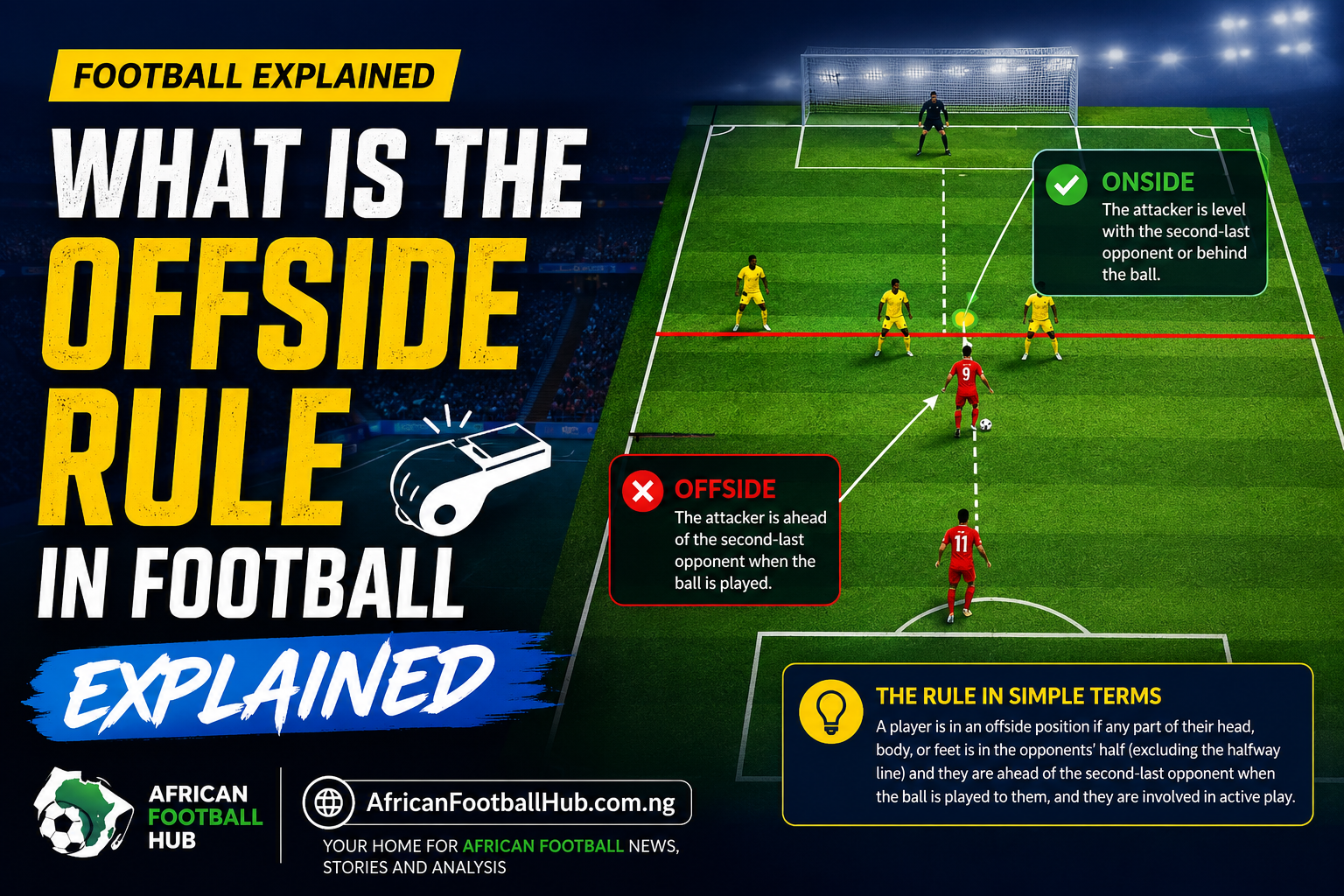
What is the offside rule in football explained in simple terms: a player is offside when any part of their body that can legally touch the ball is closer to the opponent’s goal line than both the ball and the second-last defender, at the exact moment a teammate plays the ball. That is the core of Law 11. Everything else is detail built on top of that foundation. This guide breaks it all down clearly, from the basics to the tricky situations that even experienced fans argue about.
The Basic Offside Rule: What Law 11 Actually Says
Law 11 of the Laws of the Game, set by the International Football Association Board (IFAB), governs offside. It has two parts that matter separately: the offside position and the offside offence.
Being in an offside position is not automatically a crime. A player can stand in an offside position all day without breaking any rule. The referee only flags it as an offence when the player becomes involved in active play.
What Is an Offside Position?
A player is in an offside position when all three of these conditions are true at the same time:
- They are in the opponent’s half of the pitch
- Any part of their head, body, or feet is closer to the opponent’s goal line than the ball
- Any part of their head, body, or feet is closer to the opponent’s goal line than the second-last opponent (usually the last outfield defender)
The arms are not included. Hands and arms cannot score or control the ball, so IFAB removed them from the offside equation. Only body parts that can legally play the ball count.
The second-last opponent is usually the last outfield defender when the goalkeeper is also on the pitch. In most situations, that just means the last defender. But if the goalkeeper leaves their line or is absent, it changes.
What Makes It an Offside Offence?
A player in an offside position commits an offside offence only when they become involved in active play by doing any of the following:
- Touching or playing the ball
- Blocking an opponent’s view of the ball
- Challenging an opponent for the ball
- Clearly making a move to play the ball that impacts an opponent
- Touching the ball after it rebounds off the goalpost, crossbar, or goalkeeper
The key moment is when the ball is played by the teammate, not when the offside player receives it. That timing is everything. The assistant referee watches the moment of the pass, not the moment of receipt.
When Is a Player NOT Offside?
This is where many fans get confused. Not every situation where an attacker is ahead of a defender results in an offside call. The law has several important exceptions.
Direct Restarts: Goal Kicks, Corner Kicks and Throw-Ins
A player cannot be offside directly from any of these three restarts:
- A goal kick
- A corner kick
- A throw-in
If the ball is thrown in from the touchline and a teammate receives it while ahead of the last defender, play continues. The same applies if the ball comes from a goal kick or corner. No flag. No offside.
Receiving the Ball From a Deliberate Opponent Touch
If an opponent deliberately plays the ball, and an attacker who was in an offside position receives it next, there is no offence. The defender chose to play the ball. That clears the offside.
However, this does not apply to a deliberate save. If a goalkeeper or defender stops the ball going into the goal, that counts as a save, not a deliberate play. An attacker in an offside position who benefits from a rebound off that save is still offside.
Being Level Is Onside
A player who is exactly level with the second-last defender is onside. Level is not offside. The attacker must be clearly ahead to be penalised. In tight situations, the benefit of the doubt goes to the attacker. This is why VAR and semi-automated technology have become so important.
Defending Own Half
A player in their own half of the pitch cannot be offside. Full stop. Even if they are two centimetres behind the halfway line, they are safe.
Offside and VAR: How Decisions Are Made Today
The introduction of the Video Assistant Referee (VAR) changed how offside is enforced at the highest level. Before VAR, borderline calls were made by the assistant referee raising a flag based on their eyeline. Mistakes happened all the time.
VAR allows the video review team to examine a situation using multiple camera angles. The review team can check whether any body part that matters was ahead of the last defender at the exact moment the ball was played.
This led to goals being disallowed for shoulders, knees, and armpit edges being marginally ahead. It was technically correct. But it frustrated fans and slowed the game down significantly. Some reviews took three to four minutes to complete.
Semi-Automated Offside Technology (SAOT)
To fix the delays while keeping accuracy, FIFA introduced Semi-Automated Offside Technology (SAOT). It was first used at the 2022 World Cup in Qatar and has since been rolled out across the UEFA Champions League, Serie A, and the English Premier League.
SAOT uses around 12 tracking cameras installed under the roof of the stadium. These cameras track the ball and up to 29 data points on each player’s body simultaneously. The match ball sometimes contains a microchip that sends data to the system many times per second.
When the ball is played, the system generates a 3D model of the attacker’s position relative to the defenders. It produces a clear image that tells the video review team within approximately 25 seconds whether the player was onside or offside.
The Premier League adopted SAOT partway through the 2024 to 2025 season and confirmed it will be used throughout the 2025 to 2026 campaign. It saved around 27 seconds per offside review compared to the previous manual line-drawing method. For the 2026 World Cup, SAOT is expected to be central to all offside decisions.
What Does “Active Play” Actually Mean?
This is one of the most debated aspects of Law 11 and it still causes disagreement between coaches, fans, and referees. The law says a player in an offside position is only penalised if they become involved in active play. But what counts?
Interfering With Play
This means touching the ball. If an offside player receives and touches the ball, the referee stops play immediately. This is the clearest and most straightforward part of the rule.
Interfering With an Opponent
This is where it gets complicated. If an offside player stands in a position that blocks the goalkeeper’s view of the ball or prevents a defender from moving freely, that counts as interference even without touching the ball.
The referee must decide whether the offside player’s presence meaningfully affected the opponent. An attacker standing five metres wide and doing nothing is not interfering. An attacker standing directly in the goalkeeper’s line of sight during a shot is interfering.
Gaining an Advantage
A player gains an advantage from their offside position if they touch the ball after it rebounds off the goalkeeper, the post, or the crossbar. They were offside when the original shot was taken, the ball came back to them, and they scored. That goal is disallowed.
Real Game Situations: How to Spot Offside
Theory is one thing. Understanding offside in real time during a match is another skill entirely. Here are common in-game situations that confuse fans.
The Through Ball in Behind the Defence
A midfielder plays a pass over the top of the defensive line for a striker to run onto. At the exact moment the midfielder’s foot makes contact with the ball, the striker must be level with or behind the second-last defender. If the striker’s shoulder or knee is fractionally ahead, the flag goes up and the chance is cancelled.
The Delayed Run
A forward stands onside, then makes a run. The ball is played while they are still onside. They receive it while ahead of the last defender. This is fine. Onside. The position at the moment of the pass is what counts, not the position at the moment of receipt. This is the classic timing-your-run move that good strikers master.
The Offside Trap
A defensive team pushes up simultaneously as the ball is played in an attempt to catch the attacker in an offside position. Defenders have used this as a tactical weapon for decades. When it works, it kills an attack instantly. When it fails, the attacker is clean through on goal.
Goals from Corners and Set Pieces
No offside can be called directly from a corner kick. A player can stand on the goal line and head the ball in from a corner with no offside concern. However, if the ball is played from a corner to a teammate who then plays it to the goal line player, the standard offside law resumes at the moment of that second pass.
The Offside Rule and African Football: Why It Matters
African football fans argue about offside constantly. On match days across Lagos, Accra, Nairobi, and Cairo, goals getting ruled out by an assistant referee’s flag creates passionate debate.
At the 2022 World Cup, Morocco’s historic run featured several tight VAR checks on offside positions. Senegal, Ghana, Tunisia, and Cameroon all had moments where the rule affected their campaigns directly.
At the 2026 World Cup, SAOT is in operation. Every borderline offside decision goes through the automated system. Decisions that used to take four minutes now take around 25 seconds. African fans watching at home in Nigeria will see quicker, clearer decisions on screen.
Understanding the rule also helps fans appreciate defensive tactics. The offside trap, high defensive lines, and timed runs are all built around Law 11. When you understand offside, you understand a huge part of modern football strategy.
The Future: Could the Offside Rule Change?
There is genuine discussion in football about reforming Law 11. The most talked-about proposal is linked to Arsene Wenger, FIFA’s Chief of Global Football Development.
His proposal, sometimes called the “Wenger Rule,” would only penalise a player if their entire body is ahead of the last defender. Under current law, a fraction of a shoulder ahead is enough. Under the Wenger proposal, the attacker would be onside unless their whole body crosses the defender’s line.
The goal is to give attackers the benefit of the doubt, reduce marginal calls, and create more goalscoring opportunities. IFAB began reviewing trial data from youth competitions in 2025. A possible rollout in senior football could come in the 2026 to 2027 season or beyond, but nothing is confirmed.
For now, the current Law 11 stands. Learn it, understand it, and you will never argue a wrong offside call again.
Frequently Asked Questions
Can you be offside in your own half?
No. A player cannot be offside if they are in their own half of the pitch at the moment the ball is played. The offside rule only applies in the opponent’s half. A player two centimetres behind the halfway line is completely safe, no matter how far ahead of defenders they may appear.
Can you be offside from a throw-in?
No. A player cannot be offside directly from a throw-in, a corner kick, or a goal kick. These are dead-ball restarts, and Law 11 specifically excludes them. Normal offside rules resume the moment the ball is next played by a teammate from open play.
What happens when offside is called?
When offside is called, the referee stops play and awards an indirect free kick to the defending team. The free kick is taken from the position where the offside player was when their teammate played the ball. An indirect free kick means the ball must touch another player before a goal can be scored directly from it.
Does it matter where the offside player is when they receive the ball?
No. The position at the moment of receipt is irrelevant. What matters is where the player was at the exact moment their teammate played the ball. A player can be offside when the ball is played, sprint back onside, and then receive the ball legally, but the offside position at the moment of the pass is already the offence.

Samuel Jegede is a passionate football writer and sports enthusiast dedicated to covering African football, World Cup 2026 developments, player profiles, match analysis, and breaking news for fans across Africa and beyond.