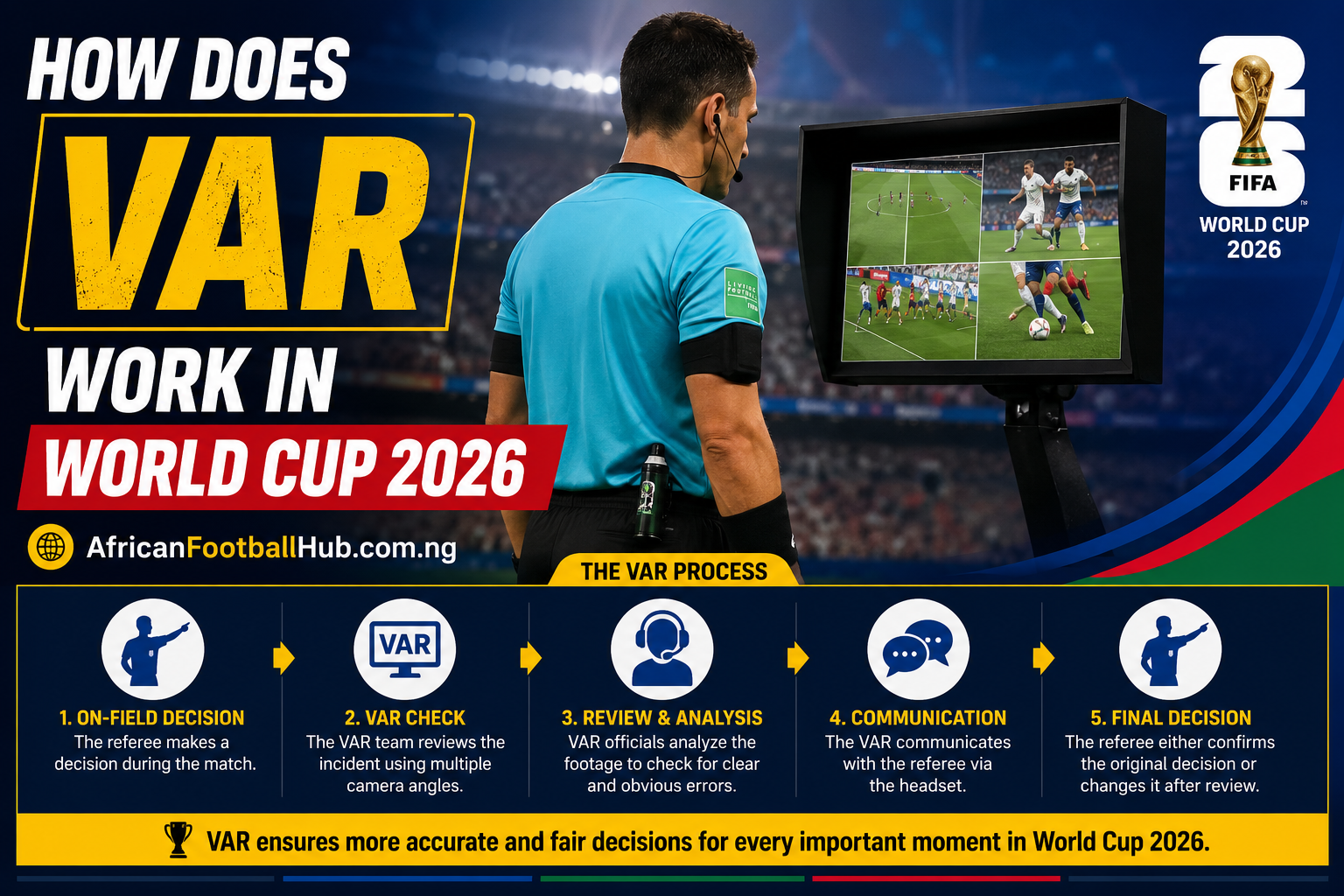
How does VAR work in World Cup 2026? In short: a team of video officials watches every match from a dedicated review centre, checking key decisions goals, penalties, red cards and mistaken identity and alerting the on-field referee when a clear error has been made. FIFA has confirmed VAR will be used at the 2026 tournament across the United States, Canada and Mexico, and understanding it properly will save you from losing your mind every time the referee stops play. Here is everything you need to know.
What Is VAR and Why Does FIFA Use It?
VAR stands for Video Assistant Referee. It is a system that uses multiple camera angles and a team of dedicated video officials to support the main referee during a match. FIFA introduced VAR at the 2018 World Cup in Russia the first time the technology appeared at football’s biggest stage and it has been used at every World Cup since.
The core goal is simple: eliminate clear and obvious errors in the four match-changing situations where mistakes hurt most. VAR is not there to review every decision. It is not designed to be perfect. It exists to catch the howlers — the missed red cards, the wrongly allowed goals, the phantom penalties — that can define a tournament for the wrong reasons.
For African fans, this matters enormously. Teams like Nigeria, Senegal, Morocco, Egypt and Cameroon have all had World Cup moments shaped by controversial refereeing. VAR is the system designed to fix that. Knowing how it works puts you in a better position to understand and debate every big call.
The Four Situations VAR Can Review
FIFA is very strict about this. VAR does not review every incident. It only intervenes in four specific categories:
1. Goals and Offences Leading to a Goal
If a goal is scored, VAR will automatically check whether the ball crossed the line legally, whether any attacking player was offside in the build-up, and whether the scorer or a teammate committed a handball or foul in the lead-up to the finish. This check happens even if the referee has already allowed the goal.
2. Penalty Decisions
VAR can recommend a review of any incident inside the penalty area — whether a penalty was incorrectly awarded or incorrectly denied. This covers fouls, handballs and simulation. If the video team spots a clear error the referee missed, they will flag it.
3. Direct Red Card Incidents
Serious foul play, violent conduct and dangerous tackles are reviewable. However, second yellow cards that lead to a red are not reviewed by VAR only straight red card offences qualify.
4. Mistaken Identity
If the referee disciplines the wrong player books or sends off someone who did not commit the offence VAR can correct it. This category exists to protect innocent players from punishment that belongs to someone else.
Anything outside these four categories corner kicks, throw-ins, yellow cards (except mistaken identity), offside in general play that does not lead to a goal is not reviewable by VAR. The referee’s on-field call stands.
Who Are the VAR Officials and Where Do They Sit?
During every World Cup 2026 match, a team of video officials will be stationed inside a dedicated Video Operation Room (VOR). This room is separate from the stadium and equipped with screens showing every available camera angle FIFA typically deploys over 30 cameras per match at World Cup level.
The VAR team consists of:
- The VAR (Video Assistant Referee): The lead video official. Only the VAR communicates directly with the on-field referee via earpiece.
- Three Assistant VARs (AVARs): They monitor specific situations offside lines, penalty area incidents, and general play feeding information to the VAR.
All VAR officials are FIFA-appointed, elite-level referees in their own right. They are not technicians they are qualified match officials who understand the laws of the game at the highest level.
Step by Step: How the VAR Review Process Works
Here is exactly what happens from the moment an incident occurs to the final decision:
- Incident happens on the pitch. The referee makes a call — or misses one entirely.
- VAR team reviews footage immediately. Using all available camera angles, the video officials assess whether a clear and obvious error has occurred in one of the four reviewable categories.
- VAR contacts the referee (or stays silent). If no error is found, play continues. If the VAR believes a clear mistake was made, they alert the on-field referee through the earpiece.
- The referee chooses to review or accept the VAR recommendation. The referee can either: (a) change the decision immediately based on the VAR’s information, or (b) walk to the pitch-side monitor to review the footage personally before deciding.
- Final decision is made. Once the referee rules, that decision is final. VAR cannot overturn a decision it has already cleared.
The key phrase in all of this is “clear and obvious error.” VAR does not intervene for tight calls or marginal decisions where the referee’s on-field judgement is reasonable. It only steps in when the footage shows an unmistakable mistake.
The Pitch-Side Monitor: When Does the Referee Go to Watch?
You have seen it: the referee jogs over to the small screen on the touchline, watches a replay for 30 to 60 seconds, then signals a decision. This is the Referee Review.
The referee will typically use the pitch-side monitor when:
- There is a violent conduct incident or dangerous tackle the referee needs to see clearly
- A penalty decision is uncertain and requires personal judgement on contact
- The VAR has flagged a potential red card offence the referee did not see in real time
For offside checks, however, the referee rarely goes to the monitor. Offside decisions are based on lines and measurements the VAR team informs the referee of the outcome and the decision is changed (or not) without a monitor review. That is why goal disallowances for offside can happen quickly, with no touchline trip involved.
Semi-Automated Offside Technology (SAOT) at World Cup 2026
This is a major upgrade FIFA has committed to continuing at the 2026 World Cup. Semi-Automated Offside Technology — first used at the 2022 World Cup in Qatar — removes human error from offside calls entirely.
Here is how it works:
- Dedicated cameras track up to 29 data points on every player’s body 50 times per second.
- When the ball is played, the system automatically maps every player’s position and draws the offside line with precision impossible for a human assistant referee with a flag.
- The result is generated in seconds and sent to the VAR team as a 3D animation you often see broadcast on TV.
SAOT made the 2022 tournament significantly faster for offside decisions. Expect the same in 2026. The days of waiting four minutes for a VAR offside check should largely be over.
Can Teams or Players Request a VAR Review?
No. This is a common misconception — and it trips up a lot of fans. Players and team officials cannot request a VAR review. Only the on-field referee and the VAR team can initiate a review.
If a player surrounds the referee demanding a VAR check, the referee is not obligated to act on that request. The review process is entirely controlled by match officials. A player can gesture towards the TV screen symbol (the rectangle drawn in the air with two fingers), but this has no official power to trigger a review — though referees are sometimes seen responding to it.
FIFA’s reasoning: if players could demand reviews, the system would be weaponised to waste time and disrupt momentum. Control stays with the officials.
What VAR Cannot Do
Understanding VAR’s limits is just as important as knowing what it covers. VAR cannot:
- Review yellow cards (except for mistaken identity involving a potential red card incident)
- Overturn a decision it has already cleared and play has continued
- Review throw-ins, corners or free kick positions
- Intervene in incidents it defines as a matter of opinion rather than a clear factual error
- Be used by teams as a challenge system (unlike rugby or cricket)
VAR also cannot change a subjective refereeing decision — for example, whether a foul was “soft” or whether a tackle was worthy of a yellow rather than a red. These judgements belong to the on-field referee. VAR only intervenes when the footage shows the decision was factually wrong, not merely debatable.
How VAR Affects African Teams at World Cup 2026
African nations have had a complicated relationship with refereeing at World Cups. From contentious offside calls against Senegal in 2002 to penalties awarded and denied in circumstances that enraged entire continents, VAR represents a genuine protection for teams that felt they lacked recourse in the past.
At the 2022 World Cup in Qatar, Morocco’s extraordinary run to the semi-finals was scrutinised at every stage — and VAR reviews consistently upheld the results. That matters. It proved the system can deliver justice when applied properly.
With Africa sending a record six teams to the 2026 World Cup — Nigeria, Senegal, Morocco, Egypt, South Africa and Cameroon among the likely qualifiers — understanding VAR gives African fans the context to engage with every decision intelligently. When a goal is ruled out, when a penalty is awarded, when a red card follows a pitch-side review: you will know exactly why.
Common VAR Controversies and What They Mean
“The lines are too thin.” Critics argue SAOT offside lines are drawn to millimetre precision for a game played in real time at full speed. FIFA’s response: the law is the law — any part of the body that can score is measured.
“It kills the atmosphere.” Delaying goal celebrations while VAR checks are completed frustrates fans inside stadiums. FIFA has tried to speed up reviews to reduce this gap.
“Handball rules are confusing.” Handball decisions — particularly accidental handball in the build-up to a goal — remain VAR’s most debated area. The law has been tweaked several times since 2018. Going into 2026, the standard FIFA uses is whether the handball gave a clear advantage to the attacking team.
“Different referees, different standards.” VAR relies on human judgement at the review stage. Different VAR officials may apply different thresholds for what counts as “clear and obvious.” This inconsistency is the system’s biggest remaining weakness.
Frequently Asked Questions
Can VAR be used for every foul at World Cup 2026?
No. VAR only reviews fouls in four specific situations: incidents leading to goals, penalty decisions, direct red card offences, and cases of mistaken identity. Every other foul is decided solely by the on-field referee and cannot be reviewed, no matter how controversial.
How long does a VAR review usually take?
Most VAR checks take between 60 and 90 seconds, though complex incidents can take longer. With Semi-Automated Offside Technology now in place, offside checks specifically are much faster — often confirmed within 30 seconds — compared to the lengthy waits seen before SAOT was introduced at the 2022 World Cup.
Does VAR use goal-line technology at the World Cup?
Goal-line technology (GLT) and VAR are separate systems, but they work together. GLT uses cameras installed around the goal to determine in under one second whether the ball fully crossed the line — this result is sent directly to the referee’s watch. VAR then confirms the overall goal decision, including checking for any offside or foul in the build-up.
Which African teams are most likely to be affected by VAR at World Cup 2026?
Every team at the tournament is subject to the same VAR process — there is no preference by nationality. However, with up to six African teams expected at the 2026 World Cup, fans of Nigeria, Senegal, Morocco, Egypt, South Africa and Cameroon should familiarise themselves with the system to understand decisions during high-stakes knockout matches where VAR calls often prove decisive.

Samuel Jegede is a passionate football writer and sports enthusiast dedicated to covering African football, World Cup 2026 developments, player profiles, match analysis, and breaking news for fans across Africa and beyond.