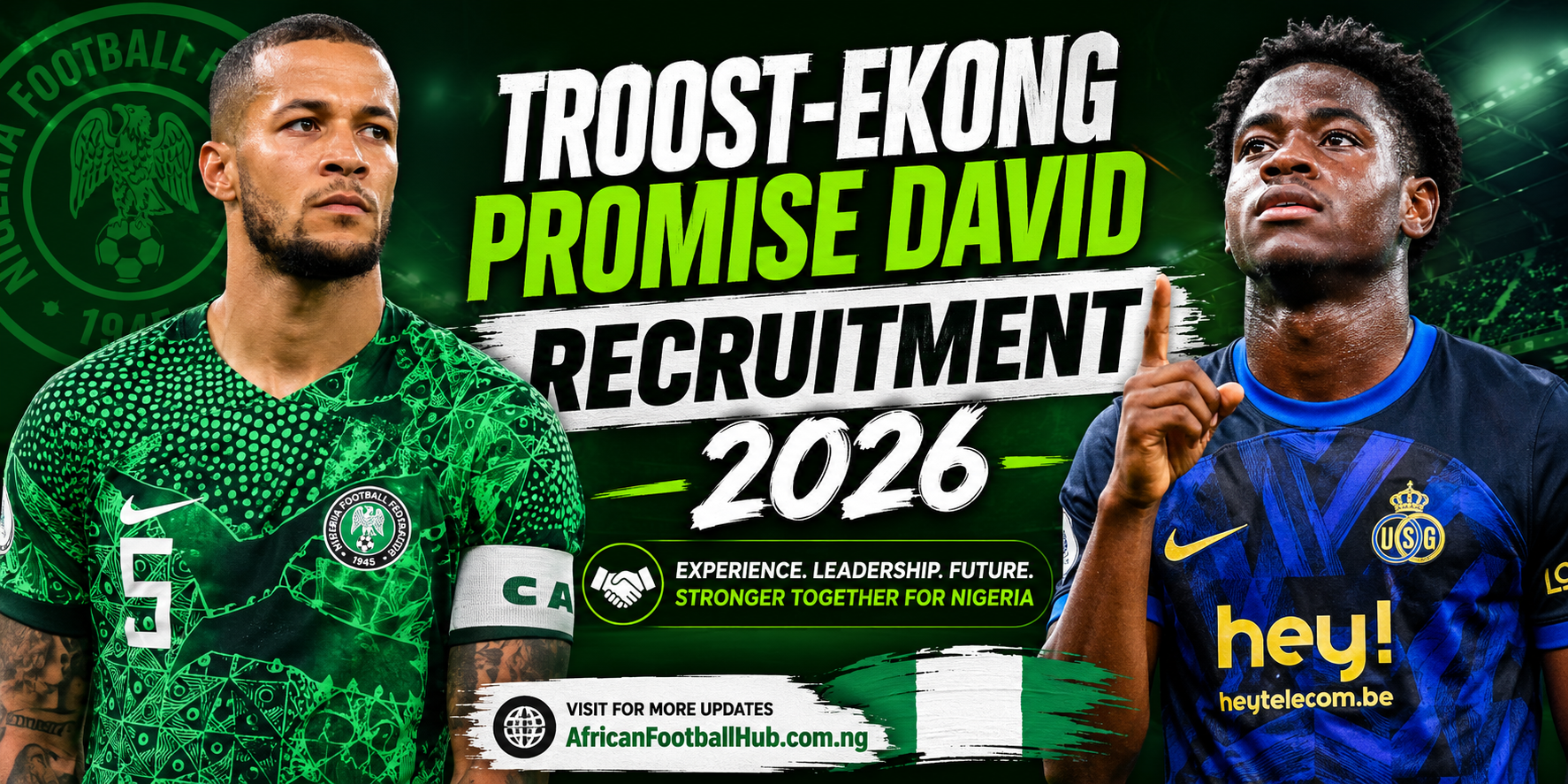
William Troost-Ekong has confirmed, on live television during the 2026 FIFA World Cup, that he personally held recruitment talks with Canadian striker Promise David in an attempt to persuade him to represent Nigeria at senior level. David, who is of Nigerian descent and actually featured for Nigeria’s Under-23 team in 2023, chose Canada instead and is now at the World Cup on home soil, scoring goals and giving assists while Nigeria watches from the sidelines. This article covers every detail of how that recruitment conversation went, how Promise David ended up in a Canada shirt, and what the whole episode tells Nigerian football about the choices it keeps losing.
Key Facts: Troost-Ekong and Promise David
Player in Question: Promise Oluwatobi Emmanuel David Akinpelu (born July 3, 2001)
Club: Royale Union Saint-Gilloise, Belgian Pro League
Background: Born in Ontario, Canada, to Nigerian immigrant parents
Nigeria U-23 Appearance: 2023 U23 AFCON qualifier vs Tanzania (competitive match)
FIFA Switch Approval: February 21, 2025
Canada Senior Debut: June 7, 2025 vs Ukraine (also scored in that game)
Who Tried to Recruit Him for Nigeria: William Troost-Ekong, former Super Eagles captain
Where Troost-Ekong Confirmed This: SuperSport broadcast, June 2026 World Cup coverage
Nigeria Did Not Get Him
Who Is Promise David and Why Did Nigeria Ever Have a Chance?
Promise David is a 24-year-old forward who plays for Royale Union Saint-Gilloise in Belgium. His full registered name is Promise Oluwatobi Emmanuel David Akinpelu. He was born in Ontario, Canada, on July 3, 2001, to Nigerian parents who had migrated to Canada. That Nigerian parentage is precisely what gave the Nigeria Football Federation a window to recruit him, and it is the same window Troost-Ekong tried to push open.
His career path is not one you would describe as conventional. He started with Toronto FC’s youth academy, then moved through clubs in Croatia, Malta, Estonia, and eventually Belgium, where he landed at Royale Union Saint-Gilloise and genuinely found his level. At Union SG, he scored 15 goals in 37 appearances in the 2025/26 season. That kind of output for a Belgian Pro League side puts you on the radar quickly, which is exactly what happened.
The Nigeria connection was not just on paper. In 2023, David actually featured for Nigeria’s U-23 team in a 2023 U23 Africa Cup of Nations qualifier against Tanzania. That was a competitive international match, not a friendly. This is important because it meant he needed FIFA’s formal approval to switch his allegiance to Canada at senior level. It was not as simple as just changing his mind. FIFA had to review his case, and he received that approval on February 21, 2025. Before that approval came through, Nigeria theoretically still had a chance of keeping him.
Quick Context: Both Tani Oluwaseyi and Owen Goodman, who also have Nigerian heritage, are in Canada’s 2026 World Cup squad alongside Promise David. Oluwaseyi was born in Abuja before moving to Canada at age 10.
Troost-Ekong’s Recruitment Attempt: What He Said and When It Happened
Troost-Ekong did not go into deep detail about when exactly he spoke to David or through what channel, but he confirmed on SuperSport during the 2026 World Cup coverage that the conversation happened. His words, as monitored by AllNigeriaSoccer.com, were direct: “His rise has been meteoric, and of course, he is of Nigerian descent, so we had a conversation about playing for Nigeria. I tried my best to convince him.”
William Troost-Ekong, SuperSport, June 2026
The phrase “I tried my best” is honest in a way that Nigerian football fans will find both refreshing and painful. It means the conversation happened. It means someone from the Nigerian football world reached out, made a case, and lost the argument. Troost-Ekong did not blame David for his choice. He went on to praise him after David scored in Canada’s 2-1 group stage loss to Switzerland, saying the striker took his chance brilliantly and that his goal added depth to Canada’s attack.
Based on the timeline, Troost-Ekong’s recruitment attempt most likely occurred before January 2025, when David publicly stated he was focused on playing for Canada at senior level. The NFF had also been making inquiries at that same period, according to Wikipedia’s entry on David. So the Nigeria camp was genuinely trying. The door just closed firmly when FIFA approved David’s switch to Canada in February 2025.
Timeline Note: David’s FIFA clearance to represent Canada came on February 21, 2025. After that date, any Nigerian recruitment attempt was no longer possible under international football rules.
The Full Picture: How Promise David’s Nationality Choice Unfolded
His Early Nigeria Connection
Playing for Nigeria’s U-23 team in a competitive qualifier is not a small thing. It is a conscious choice. In 2023, Promise David was already on Nigeria’s radar at the youth level, and he accepted the call-up, flew in, and played. At that point, the argument inside the NFF should have been straightforward: get this kid tied down to Nigeria before he makes up his mind at senior level. That did not happen quickly enough.
When Nigeria Came Calling at Senior Level
According to Wikipedia’s entry on David, the Nigerian Football Federation made inquiries about his international future in January 2025. David’s response was that he was focused on Canada. He was 23 years old, his career was accelerating at Union SG, Canada was preparing for a home World Cup in 2026, and the Canadian national team was in a genuine period of growth. Against all of that, Nigeria’s pitch was competing from a weaker position. The Super Eagles had just missed the 2022 World Cup in Qatar and were navigating another qualification campaign with uncertain outcomes.
How the FIFA Switch Was Processed
Because David had played in a competitive match for Nigeria’s U-23s, he could not simply represent Canada without FIFA’s clearance. He submitted the formal application and on February 21, 2025, FIFA approved the switch. From that point, he was a Canadian player in every legal and sporting sense. He made his senior debut for Canada on June 7, 2025, in a 4-2 friendly win over Ukraine, and scored in that game. He then appeared at the 2025 CONCACAF Gold Cup before recovering from a hip injury in early 2026 to make Canada’s 26-man World Cup squad.
Documents and Timeline of the Promise David Nationality Story
| Event | Details and Notes |
|---|---|
| Born | July 3, 2001, Ontario, Canada, to Nigerian parents |
| 2023 Nigeria U-23 Appearance | Featured in a competitive U23 AFCON qualifier against Tanzania; this triggered the FIFA transfer-of-allegiance requirement |
| January 2025 | NFF made formal inquiries about his international future; David stated he was focused on Canada |
| February 21, 2025 | FIFA formally approved his transfer of allegiance from Nigeria to Canada |
| March 12, 2025 | Received his first senior call-up to Canada for the 2025 CONCACAF Nations League Finals |
| June 7, 2025 | Made his Canada senior debut and scored in a 4-2 friendly victory against Ukraine |
| February 2026 | Suffered a hip injury with Royale Union Saint-Gilloise; World Cup place in doubt |
| May 29, 2026 | Named in Canada’s 26-man squad for the 2026 FIFA World Cup |
| June 2026 World Cup | Contributed a goal or an assist in both matches he featured in; scored in Canada’s 2-1 loss to Switzerland |
| June 25, 2026 | Troost-Ekong confirms on SuperSport that he personally tried to recruit David to the Super Eagles |
How Nigeria Loses Players Like This: The Recurring Pattern
The Promise David situation is not a one-off. It is a chapter in a much longer book that Nigerian football keeps writing. At the 2026 World Cup, more than 16 players of Nigerian descent are representing other countries. Folarin Balogun is scoring braces for the United States. Michael Olise is creating goals for France. Bukayo Saka is assisting for England. Felix Nmecha and Jamal Musiala have Nigerian fathers and are playing for Germany. Carney Chukwuemeka switched from England to Austria. Tani Oluwaseyi and Promise David are both at Canada.
Each of these players had a version of the conversation that Troost-Ekong says he had with David. Some were approached early, some were approached late, and most chose the country that offered them the clearest pathway to major tournaments. Nigeria missed the 2022 World Cup in Qatar and failed again for 2026 after losing a playoff to DR Congo on penalties. A country that cannot qualify for the World Cup is going to lose the nationality argument against countries that can.
Nigeria regularly approaches diaspora players after they have already settled into youth setups elsewhere. By the time the NFF came to David in January 2025, he had already been playing senior football at a high level in Belgium for two years. The conversation should have started no later than 2022.
Canada was preparing for a home World Cup. Nigeria had just missed out in 2022 and was in danger of missing 2026 too. For a young attacker who wants to play on the biggest stage, the country that offers a World Cup spot will beat the one that cannot guarantee it.
David played for Nigeria’s U-23 team in a competitive match in 2023. That should have triggered an immediate effort to secure his senior allegiance before FIFA’s transfer window closed. It took until January 2025 for formal NFF inquiries to happen, by which point his mind was already made up.
Playing for Nigeria at U-23 level in competitive matches requires FIFA clearance to switch, but it does not automatically lock the player to Nigeria at senior level. The NFF needed to convert that U-23 appearance into a senior commitment quickly. They did not.
What Happens After Nigeria Loses a Recruitment Battle Like This
-
The Player Is Registered Internationally for Another CountryOnce FIFA approves a transfer of allegiance, as they did for Promise David on February 21, 2025, the situation is permanent unless specific circumstances apply for a further switch. Nigeria cannot approach David again. He is a Canadian international.
-
Nigeria Fans Watch Him Perform at Major Tournaments
David scored at the 2026 World Cup and provided an assist in the tournament. Nigeria was not at the World Cup. The contrast becomes a public conversation that puts pressure on the NFF and NFF leadership every time a Nigerian-heritage player shines for another country.
-
A Broader Review of Diaspora Recruitment Policy Gets Proposed
After each major tournament, Nigerian football writers and stakeholders call for a structured approach to diaspora player identification and recruitment. Whether those calls ever translate into a functioning system at the NFF level is a different question entirely.
-
The Cycle Repeats with a Different Player
The 2030 World Cup cycle will bring the same conversation about a different set of young players with Nigerian heritage who are growing up in Europe or North America. If Nigeria qualifies for the 2030 World Cup and builds on it, the pitch gets easier. If not, the battle will be harder every time.
Frequently Asked Questions
Did Troost-Ekong personally speak to Promise David about playing for Nigeria?
Why did Promise David choose Canada over Nigeria?
Did Promise David play for Nigeria before switching to Canada?
What club does Promise David play for?
How did Promise David perform at the 2026 World Cup?
Are there other players of Nigerian descent in Canada’s 2026 World Cup squad?
Can Nigeria still recruit Promise David in the future?
Final Word
Troost-Ekong tried. That much is now public record. He sat down with Promise David, made the case for the Super Eagles, and walked away without a yes. Whether the conversation happened in person, over a phone call, or through intermediaries is not clear, but the outcome is: a striker born to Nigerian parents, who actually wore a Nigerian jersey in a competitive match, is now scoring goals at a World Cup that Nigeria is not attending.
The pattern here is not new, and the frustration is genuine. Nigeria produces football talent at a rate that is almost embarrassing given the country’s infrastructure challenges. But production without retention is just a donation to other nations’ squads. The NFF needs a functioning diaspora identification programme, one that spots players before clubs do, builds relationships before FIFA transfer windows open, and makes the Nigeria option appealing on merit, not just on sentiment. Troost-Ekong’s individual effort was commendable. Relying on individual players to do that recruitment work informally is not a strategy.
For Promise David himself, the honest truth is that his decision made sense. He was born in Canada. He grew up there. His country was hosting a World Cup. He recovered from hip surgery and made the squad. He scored. That is a football career going exactly the way a player wants. Nigeria fans can be disappointed without being angry at him. The people to be angry at are the ones who should have had a system in place years ago to make him feel that the Nigeria option was genuinely worth choosing.
Disclaimer
This article is published for informational and editorial purposes by AfricanFootballHub. All facts, quotes, and dates are sourced from verified reports published by AllNigeriaSoccer.com, Daily Post Nigeria, Premium Times, Vanguard, Yahoo Sports, and the official Wikipedia profiles of William Troost-Ekong and Promise David, as of June 25, 2026. The quote attributed to Troost-Ekong was sourced from AllNigeriaSoccer.com, which monitored the SuperSport broadcast. AfricanFootballHub.com.ng is an independent Nigerian media platform and is not affiliated with the NFF, Canada Soccer, or any football federation.

Samuel Jegede is a passionate football writer and sports enthusiast dedicated to covering African football, World Cup 2026 developments, player profiles, match analysis, and breaking news for fans across Africa and beyond.