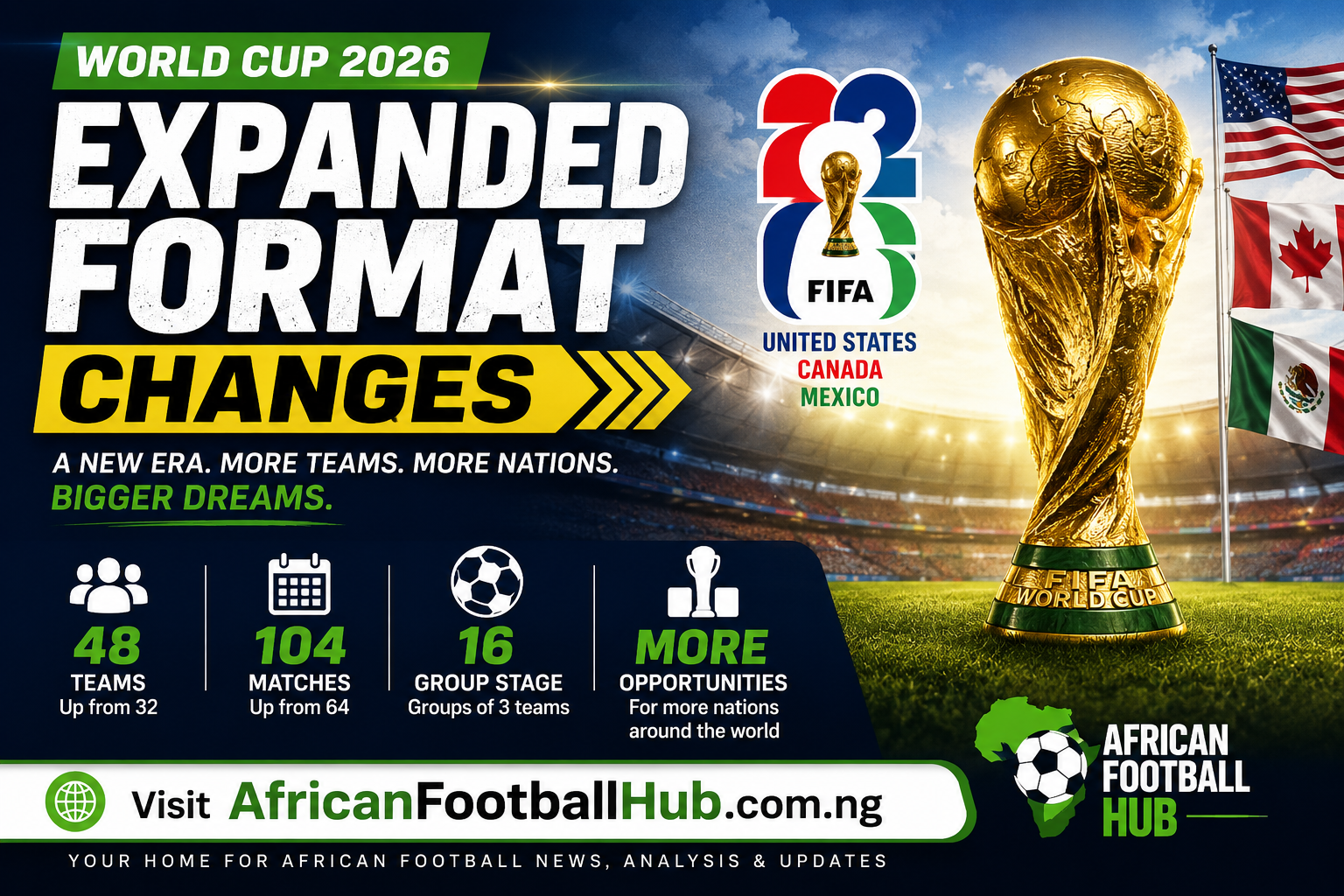
The World Cup 2026 expanded format changes are the biggest shake-up in the tournament’s history. For the first time ever, 48 nations will compete up from the 32-team format used since 1998. That means more matches, a redesigned group stage, new knockout rounds, and crucially, more spots for African teams. If you want to understand exactly what is different and why it matters to Nigeria and the rest of the continent, this guide covers everything.
Why FIFA Expanded the World Cup to 48 Teams
FIFA made the decision to expand the World Cup from 32 to 48 teams back in 2017, with then-president Gianni Infantino leading the push. The arguments were straightforward: more nations involved means more commercial revenue, broader global reach, and greater representation for football confederations that had long been underserved by the old format.
Critics pushed back. Many argued that adding 16 more teams would dilute the quality of football and produce mismatched group stage games. Supporters countered that major upsets think Cameroon beating Argentina in 1990, Senegal shocking France in 2002, or Morocco dismantling Portugal in 2022 have always come from “smaller” nations being given the chance to compete. More teams means more of those moments.
The 2026 tournament will be hosted across three countries the United States, Canada and Mexico with 16 host cities and 80 total matches on the schedule. The infrastructure to handle an expanded tournament already exists. There are no excuses not to go big.
The New Group Stage Format: 12 Groups of Four
This is where the format change gets interesting — and slightly complicated. Under the old 32-team model, there were eight groups of four teams. Simple. Under the new 48-team structure, FIFA has moved to 12 groups of four teams.
Here is how it breaks down:
- 48 teams are split into 12 groups
- Each group contains four teams
- Each team plays three group stage matches
- The top two teams in every group automatically advance to the Round of 32
- The eight best third-placed teams from across all 12 groups also qualify for the next round
That last point is critical. In the old format, only the top two teams in a group of four survived. Now, finishing third is not necessarily the end — if your third-place finish is good enough compared to other third-placed teams across the 12 groups, you go through. This adds a serious tactical dimension to the final group matches and keeps more teams alive going into matchday three.
It also means more jeopardy. Teams cannot rest players as easily in the final group game if third place is not guaranteed to advance. Every point matters.
The Round of 32: The Brand New Stage
The Round of 32 is entirely new to the World Cup. It has never existed before at this tournament. In the old format, the knockout stage began at the Round of 16. Now there is an extra round of matches before that.
After the group stage, 32 teams advance: 24 group winners and runners-up, plus the eight best third-placed finishers. These 32 teams then play one-legged knockout ties to reach the Round of 16.
What does this mean in practice? It adds at least one more high-stakes knockout match for every surviving team. For African nations that historically struggled to get past the Round of 16 — Nigeria’s best finish remains the Round of 16 from their appearances in 1994, 1998 and 2014 — there is now an extra hurdle to clear. But there is also an extra chance to produce a giant-killing moment on the world stage.
The full knockout path after the group stage now looks like this:
- Round of 32 (new)
- Round of 16
- Quarter-finals
- Semi-finals
- Third-place play-off
- Final
The final is scheduled for 19 July 2026 at MetLife Stadium in New Jersey, United States — one of the largest stadiums in North America, with a capacity of over 82,000.
How Many More Matches Will Be Played?
The jump from 32 to 48 teams means a significant increase in total match volume. The 2022 World Cup in Qatar featured 64 matches. The 2026 World Cup will feature 104 matches — a 62.5 percent increase.
That is 104 opportunities for television broadcasters, sponsors, and — most importantly — fans around the world to watch World Cup football. For African viewers, it means more matches broadcast across the continent, more air time for African teams, and a longer tournament experience overall.
The group stage alone will produce 48 matches across 12 groups. From the Round of 32 onwards, there are 32 additional knockout matches before a single ball is kicked in the final. The tournament runs from 11 June to 19 July 2026 — 39 days in total.
Africa Gets More Slots: From 5 to 9 Teams
This is the single most important change for African football fans. Under the old 32-team format, CAF (the Confederation of African Football) received five guaranteed places at the World Cup. At the 2026 tournament, Africa will have nine confirmed spots.
That is nearly double the previous allocation — and a direct result of the expanded format. FIFA distributed the additional 16 slots across all six confederations, with CAF receiving the joint-highest increase alongside CONMEBOL (South America) and UEFA (Europe).
Nine African teams at a single World Cup is a historic milestone. It means the continent’s depth — which anyone who follows AFCON knows is enormous — will finally get proper representation. Countries like Nigeria, Senegal, Morocco, Egypt, Cameroon, Ivory Coast, Algeria, South Africa and Ghana all realistically have pathways to the tournament.
The CAF qualification process for 2026 uses a round-robin group stage format across 9 groups of African nations, with group winners and the best runner-up qualifying automatically, and other runners-up entering an inter-confederation play-off. The full picture of which nine African nations will make it to 2026 will become clear after the final round of qualifying matches.
What Happens to Match Quality With 48 Teams?
The fairest criticism of the expanded format is that some group stage games could be very one-sided — strong European or South American sides against nations with significantly less international pedigree. This concern is legitimate. Not every one of the 48 teams is at the same level, and a 7-0 group game helps nobody.
However, the counterargument is equally valid. The 2022 World Cup in Qatar proved beyond doubt that African and Asian teams can compete. Morocco reached the semi-finals. Saudi Arabia beat Argentina. South Korea eliminated Germany. Japan topped a group containing Spain and Germany. The idea that non-European, non-South American teams are automatic pushovers has been comprehensively disproved.
FIFA’s position is that a broader tournament strengthens football globally — not just in the short term, but because greater exposure means greater investment in football infrastructure across developing nations over the next decade. Nine African teams in 2026, performing on the world stage, has long-term consequences for the continent’s football development that go far beyond a single tournament.
The Three-Country Host Setup and What It Means for Travel
For the first time, the World Cup is being co-hosted by three nations: the United States, Canada and Mexico. There are 16 host cities spread across the three countries, including New York/New Jersey, Los Angeles, Dallas, Miami, Toronto, Vancouver, Mexico City and Guadalajara.
The logistics of a three-country tournament are complex. Teams may need to travel thousands of kilometres between group stage venues domestic flights will be a regular feature of the 2026 experience in a way they never were in Qatar, where the entire tournament was within a 60-kilometre radius.
For African supporters travelling to support their nations, the most affordable entry points are likely Miami and New York, both of which have strong African diaspora communities and regular direct flights from Lagos, Accra, Nairobi and Johannesburg. Group stage draws will be critical a group based across cities in the south of the United States will be far more accessible for African fans than one spread between Canada and Mexico.
Key Dates for World Cup 2026
- Tournament start: 11 June 2026
- Group stage concludes: Late June 2026
- Round of 32: Early July 2026
- Quarter-finals: Mid-July 2026
- Semi-finals: 14–15 July 2026
- Final: 19 July 2026, MetLife Stadium, New Jersey
The tournament is 39 days long five days longer than the 2022 World Cup to accommodate the additional matches generated by the expanded 48-team field.
What the Expanded Format Means for Nigeria Specifically
Nigeria’s Super Eagles have qualified for seven World Cups, with their best runs coming in 1994 (Quarter-finals) and 1998 and 2014 (Round of 16). Under the new format, Nigeria’s pathway through the tournament changes structurally.
With nine African berths available, qualification from CAF is slightly more achievable — though the competition remains fierce. Once at the tournament, Nigeria would face the group stage in a 12-group format where finishing third is not automatically fatal. A point total that once sent a team home can now, in some cases, keep them alive.
The Round of 32 adds another match before the Round of 16 — meaning Nigeria would need to win four knockout games, not three, to reach the semi-finals. But the additional match also means an extra occasion to build momentum, to settle players into tournament football, and to give a squad depth that coaches like to have.
The 2026 World Cup, with its expanded format, gives African football the greatest stage it has ever had. Nine teams. 104 matches. A brand new knockout round. This is not just an incremental change it is a restructuring of world football’s most important competition.
Frequently Asked Questions
How many teams are in the World Cup 2026 expanded format?
The 2026 World Cup features 48 teams — up from 32 at every World Cup since 1998. The 48 teams are divided into 12 groups of four, with group winners, runners-up, and the eight best third-placed teams advancing to the new Round of 32 knockout stage.
How many African teams qualify for World Cup 2026?
Africa receives nine guaranteed spots at the 2026 World Cup, compared to five at the 2022 tournament in Qatar. This is the largest allocation CAF has ever received at a FIFA World Cup and is a direct result of the expanded 48-team format.
What is the Round of 32 at World Cup 2026?
The Round of 32 is an entirely new knockout stage introduced for the first time at the 2026 World Cup. It takes place immediately after the group stage, with all 32 qualified teams competing in one-legged knockout ties before the traditional Round of 16 begins.
How many matches will be played at World Cup 2026?
A total of 104 matches will be played at the 2026 World Cup a significant increase from the 64 matches at the 2022 tournament in Qatar. The tournament spans 39 days across 16 host cities in the United States, Canada and Mexico, running from 11 June to 19 July 2026.

Samuel Jegede is a passionate football writer and sports enthusiast dedicated to covering African football, World Cup 2026 developments, player profiles, match analysis, and breaking news for fans across Africa and beyond.