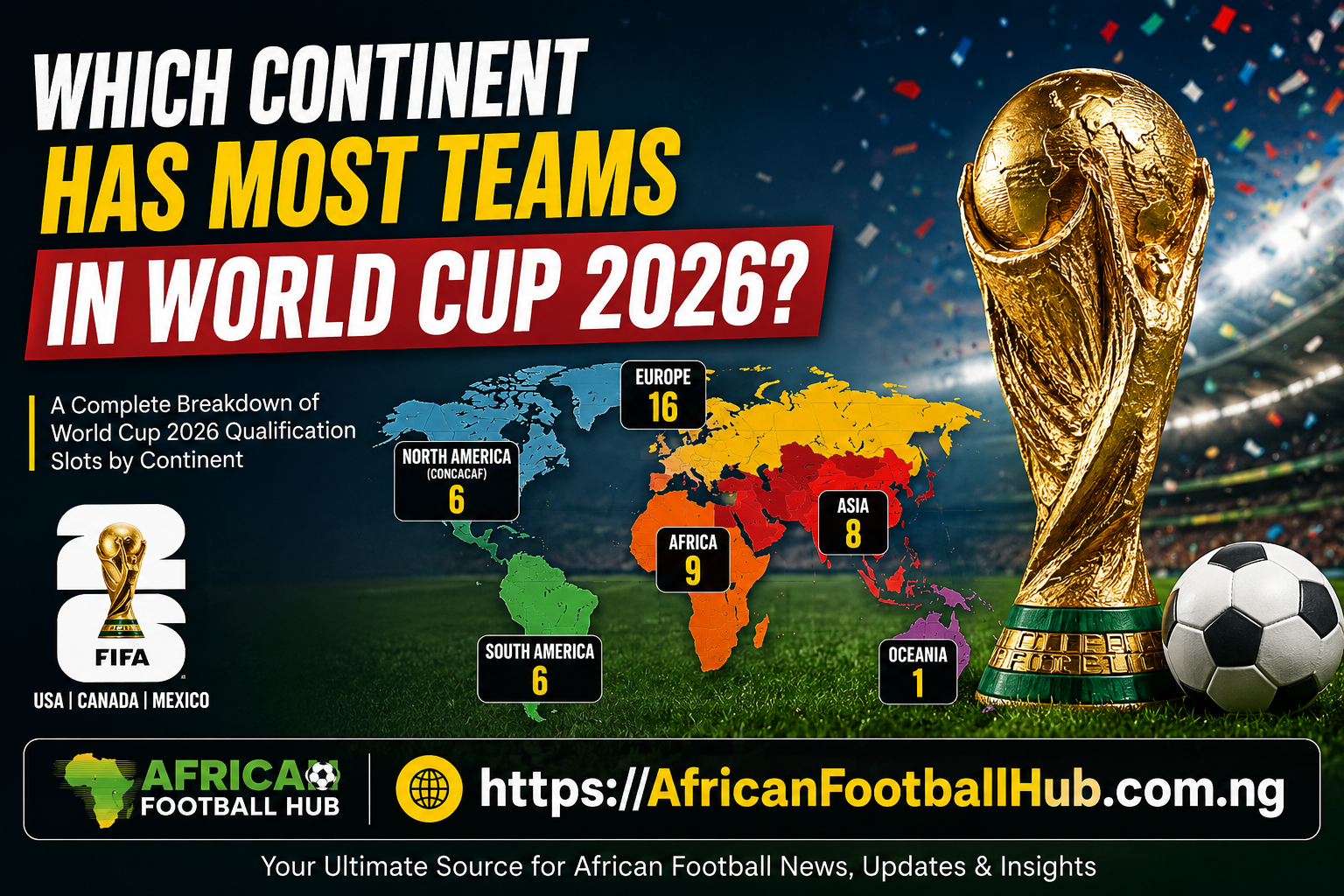
If you are asking which continent has most teams in World Cup 2026, the answer is Europe — UEFA receives 16 spots out of the 48 available, more than any other confederation. But the bigger story is what the expanded format does for every other continent, especially Africa. CAF jumps from five teams to nine nearly double its previous allocation. This guide breaks down every confederation’s quota, explains how FIFA distributed the new slots, and tells you exactly what it means for African football.
The Full Confederation Breakdown for World Cup 2026
FIFA expanded the World Cup from 32 to 48 teams for 2026. Those 16 extra places were distributed across all six confederations based on a combination of global football development priorities, competitive strength, and commercial considerations. Here is how every confederation’s allocation looks:
- UEFA (Europe): 16 teams
- CAF (Africa): 9 teams
- CONMEBOL (South America): 6 teams
- AFC (Asia): 8 teams (including one inter-confederation play-off spot)
- CONCACAF (North & Central America and Caribbean): 6 teams (including host nations USA, Canada and Mexico)
- OFC (Oceania): 1 team (via inter-confederation play-off)
- Inter-confederation play-offs: 2 additional spots contested across confederations
Europe’s 16 slots make UEFA the dominant confederation by raw numbers — and that has been the case at every World Cup since the tournament began. But the gains made by Africa and Asia in 2026 represent a genuine shift in how FIFA views the global game.
Why Europe Has the Most Teams at Every World Cup
Europe’s dominance in World Cup allocation is not accidental. UEFA has 55 member associations — more than any other confederation — and the overall quality of European football, measured by FIFA rankings, club competition performance, and World Cup results, has historically been the strongest of any continent.
At the 2022 World Cup in Qatar, 13 UEFA nations competed. In 2026 that rises to 16. European clubs dominate the global transfer market. European leagues attract the best players from every continent. And UEFA’s own qualification process — a gruelling campaign of home and away matches across diverse climates and playing styles — is one of the most competitive qualification routes in world football.
Critics argue that Europe’s allocation is disproportionate relative to the global spread of football. FIFA’s counterargument is that confederation slots are partly based on competitive merit and viewership numbers. European matches drive huge broadcast audiences. Until other confederations consistently challenge that commercial reality, Europe’s numerical advantage is unlikely to disappear entirely.
That said, 16 teams out of 48 means Europe now accounts for exactly one-third of the tournament — the same proportional share it held when the World Cup was 32 teams and Europe had 13 spots. So Europe’s relative influence has not grown; it has simply scaled with the overall expansion.
Africa’s Historic Nine Spots: The Biggest Gain of the Expansion
Africa’s jump from five to nine teams is the most significant proportional increase of any confederation in the 2026 expansion. It is not just a number — it is a statement about where FIFA sees the future of world football.
For context: in 1994, when the USA last hosted the World Cup, Africa had just three places. By 1998, that rose to five. It stayed at five for the next six World Cups — 2002, 2006, 2010, 2014, 2018 and 2022. Twenty-four years at five teams.
Now, in a single expansion, Africa goes to nine. That is an increase of four slots — more than any other confederation received in absolute terms, matched only by Europe’s gain of three additional places (from 13 to 16).
What does nine African teams look like in practice? Based on current FIFA rankings and CAF qualification form heading into 2026, the nine spots could plausibly go to nations including Morocco, Senegal, Nigeria, Egypt, Cameroon, Ivory Coast, Algeria, South Africa and Tunisia though qualification is never guaranteed until the final whistle blows on matchday. CAF’s qualification format pits all 54 African nations against each other in a group stage system, with the top finishers earning their World Cup tickets.
Nine African teams at a single World Cup is unprecedented. AFCON — the Africa Cup of Nations only involves 24 teams. The idea that nearly half an AFCON field could appear at one World Cup tells you everything about how much African football’s global footprint is growing.
Asia’s Eight Spots: A Significant Rise for AFC
Asia was historically one of the most underrepresented confederations at the World Cup relative to the size of its football population. At the 2022 World Cup, AFC had four guaranteed spots plus one play-off place — five in total. For 2026, that rises to eight spots, including one inter-confederation play-off position.
The 2022 tournament made the case for Asian football like nothing before it. Saudi Arabia beat Argentina in the group stage. Japan topped a group containing Spain and Germany. South Korea advanced from their group. Australia reached the Round of 16. Asian football’s argument for more places was made on the pitch, not in boardrooms.
For African fans, Asia’s expansion is relevant because it shows FIFA’s commitment to genuine global representation — not just a token gesture. When the continent that beat Argentina and eliminated Germany gets more seats at the table, it reinforces the principle that merit-based expansion serves world football better than a closed shop.
South America: Six Spots for CONMEBOL
South America has long punched above its weight at World Cups. With only ten member nations, CONMEBOL consistently produces World Cup winners and contenders. Argentina are the reigning world champions. Brazil are five-time winners. Uruguay, Colombia and Ecuador have all caused major upsets at recent tournaments.
For 2026, CONMEBOL receives six guaranteed spots — up from the 4.5 (four automatic plus one play-off) that the confederation had previously. Given that CONMEBOL only has ten nations total, six spots means 60 percent of South American countries will be at the World Cup. That is an extraordinary rate of participation.
South America’s qualification process the CONMEBOL round-robin where all ten nations play each other home and away is widely regarded as the most demanding qualification campaign in world football. Every match is high-stakes. There is nowhere to hide. The teams that survive it arrive at the World Cup battle-hardened.
CONCACAF: Six Spots Including Three Automatic Host Nations
CONCACAF covers North America, Central America and the Caribbean. For 2026, the confederation has six spots in total — but three of those are automatically taken by the host nations: the United States, Canada and Mexico, who qualify by right as co-hosts regardless of their FIFA rankings or form.
That leaves three additional CONCACAF spots to be contested through qualification. This has created a genuinely competitive CONCACAF qualifying campaign, with nations like Jamaica, Honduras, Panama, Costa Rica and Trinidad and Tobago all fighting for what is effectively a reduced number of competitive places.
For African fans, there is an interesting dimension here. The USA, Canada and Mexico’s automatic host qualification means three strong football nations skip the competitive qualifying process entirely. Those three spots might otherwise have gone to qualifying nations from other confederations through play-offs. FIFA’s host nation allocation is standard practice, but the three-host setup makes 2026 unique in how it affects the overall competitive balance of spots.
Oceania’s Long Road: One Play-Off Spot for OFC
The Oceania Football Confederation (OFC) covers Australia, New Zealand and Pacific island nations. However, Australia moved to the AFC in 2006, so OFC’s current strongest nation is New Zealand, followed by nations like Tahiti, Solomon Islands and Fiji.
OFC does not receive a guaranteed World Cup spot. Instead, the best OFC qualifier enters an inter-confederation play-off for a chance to reach the tournament. This has been the case for several World Cups, and it continues in 2026. Given OFC’s relatively small membership and competitive depth compared to other confederations, FIFA’s position is that automatic qualification is not yet warranted.
How the Inter-Confederation Play-Offs Work
Beyond the guaranteed confederation slots, FIFA allocates two additional spots via inter-confederation play-offs. These matches bring together nations from different confederations — teams that finished in specific positions in their own qualifying campaigns but did not earn automatic berths.
The play-off format typically involves a small tournament-style competition among the play-off participants, with the winners earning the final World Cup spots. For 2026, the inter-confederation play-offs are set to take place in 2025, with the confirmed participants drawn from AFC, CONCACAF, CONMEBOL, OFC and potentially CAF depending on qualification outcomes.
For African nations, the inter-confederation play-off represents a last-chance route if CAF’s ninth spot is involved though the primary qualification route remains the CAF group stage process. The play-offs are a safety net, not a primary pathway.
What the Confederation Breakdown Means for African Football Fans
The headline is clear: Europe has the most teams at World Cup 2026 with 16. But the real story for Nigerian and African readers is the continent’s own transformation.
Nine African teams at one World Cup changes the nature of African football on the global stage. It means more broadcast exposure for CAF nations. More commercial partnerships flowing into African football federations. More young African players performing in front of global audiences. More transfer opportunities generated by high-profile World Cup performances. And more national pride across nine countries simultaneously.
For Nigeria specifically, the Super Eagles will be competing in an expanded field where African representation is at its highest ever level. African teams facing each other in group stages is now a genuine possibility which would generate some of the most watched fixtures of the entire tournament across the continent.
Morocco’s 2022 semi-final run changed perceptions globally. Nine African teams in 2026 is the platform to change them permanently. Europe may have 16 teams. But Africa, with nine, is the confederation with the most to prove and the most to gain.
Frequently Asked Questions
Which continent has the most teams at the 2026 World Cup?
Europe has the most teams at the 2026 World Cup, with UEFA receiving 16 out of the 48 available spots exactly one-third of the total field. This is the largest allocation of any confederation and reflects both Europe’s competitive depth and its commercial significance to global football broadcasting.
How many African teams are at the World Cup 2026?
Africa has nine confirmed spots at the 2026 World Cup through CAF, up from five at the 2022 tournament in Qatar. This is the largest allocation Africa has ever received at a FIFA World Cup and is the biggest proportional gain of any confederation in the expanded 48-team format.
Did Asia get more World Cup spots for 2026?
Yes. The AFC (Asian Football Confederation) went from approximately five spots in 2022 to eight spots in 2026, including one inter-confederation play-off position. Asia’s increased allocation reflects strong performances at recent World Cups, including Saudi Arabia beating Argentina and Japan topping their group ahead of Spain and Germany at the 2022 tournament.
How were the 48 World Cup 2026 spots distributed between confederations?
FIFA distributed the 48 spots as follows: UEFA (Europe) 16, CAF (Africa) 9, AFC (Asia) 8, CONMEBOL (South America) 6, CONCACAF (North & Central America) 6, OFC (Oceania) 1 via play-off, plus 2 inter-confederation play-off spots. The three CONCACAF host nations USA, Canada and Mexico qualify automatically without going through competitive qualifying.

Samuel Jegede is a passionate football writer and sports enthusiast dedicated to covering African football, World Cup 2026 developments, player profiles, match analysis, and breaking news for fans across Africa and beyond.