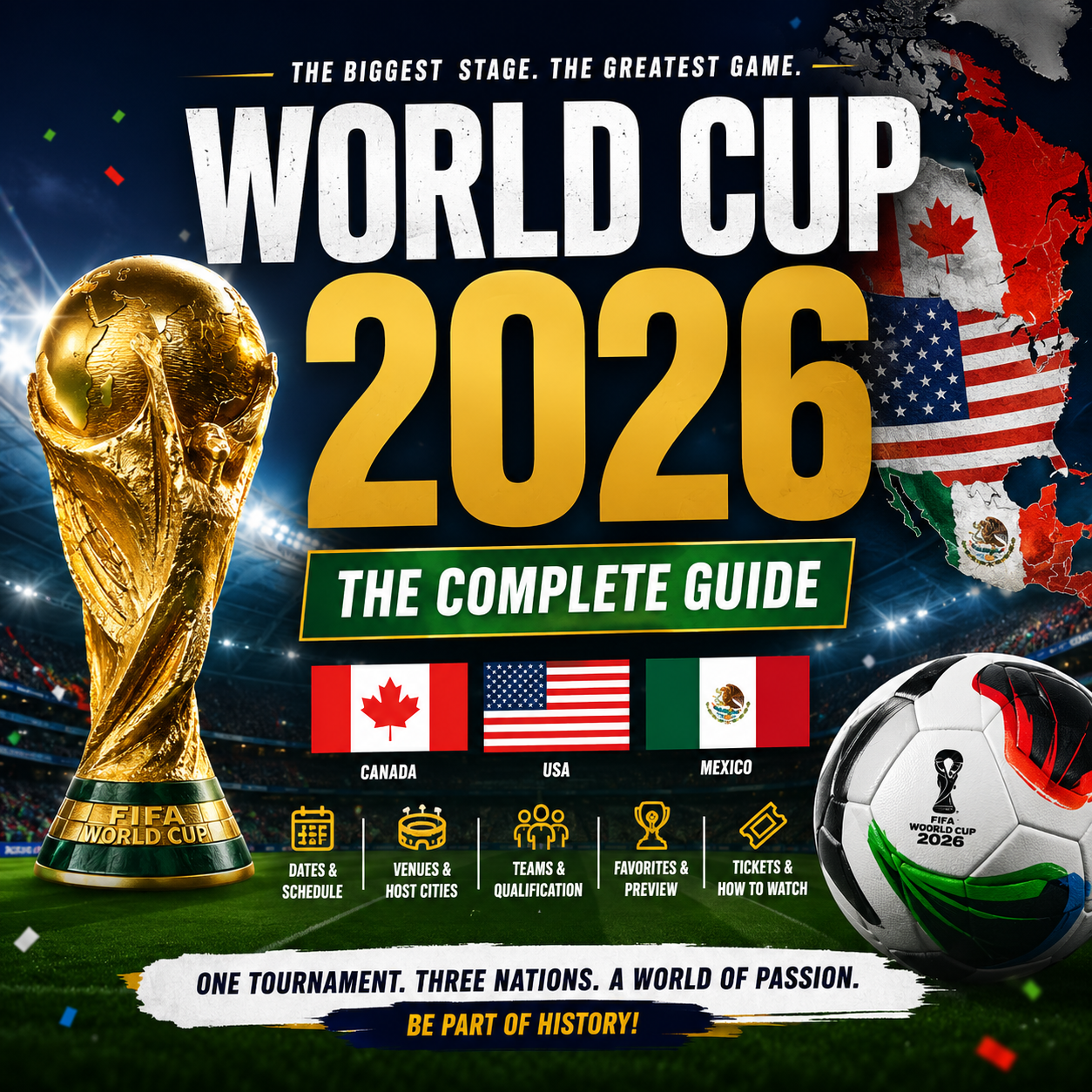
World Cup 2026 – The Complete Guide is exactly what it says: every key fact you need about the biggest football tournament on the planet, all in one place. The 2026 FIFA World Cup runs from 11 June to 19 July 2026 across the United States, Canada and Mexico. For the first time ever, 10 African nations are on the plane to North America. This guide breaks down the format, the venues, the African teams, the prize money and what to expect so you can follow every match with full context.
What Is New About the 2026 World Cup?
This is not the World Cup you grew up watching. FIFA has made the biggest structural change in the tournament’s history, expanding from 32 teams to 48. That means more countries, more matches and, crucially, more African representation.
Here is what changed:
- 48 teams instead of 32
- 104 matches instead of 64
- 12 groups of four instead of eight groups of four
- A brand-new Round of 32 knockout stage before the last 16
- Three host nations USA, Canada and Mexico instead of one
- 16 host cities spread across the continent
- Africa’s allocation increased from five spots to nine direct spots plus one playoff spot, meaning a record 10 African teams qualified
The expanded format means the group-stage exit route is less forgiving in one sense you still need to finish in the top two or be among the eight best third-placed teams but it also opens far more doors for African football than ever before.
Dates, Schedule and Key Milestones
The tournament kicks off on Thursday, 11 June 2026 with the opening match at the legendary Estadio Azteca in Mexico City, where Mexico face South Africa. That single fixture carries enormous weight for African football and it is literally the first game of the tournament.
Key dates to mark in your calendar:
- 11 June 2026 -Opening match: Mexico vs South Africa, Mexico City
- 11–27 June – Group stage
- Late June / early July – Round of 32 and Round of 16
- 4–5 July – Quarter-finals
- 14–15 July – Semi-finals (AT&T Stadium, Dallas; Mercedes-Benz Stadium, Atlanta)
- 18 July – Third-place play-off (Miami)
- 19 July 2026 – FINAL: MetLife Stadium, New York/New Jersey
Nigeria fans, take note: because of the time difference between West Africa and North America, most matches will kick off between 7 p.m. and midnight WAT. Plan your viewing parties accordingly.
The 16 Host Cities and Stadiums
The tournament is spread across three countries and 16 cities, making this the most geographically expansive World Cup in history. Here is the full breakdown:
United States (11 cities)
- New York/New Jersey – MetLife Stadium (hosts the FINAL)
- Dallas – AT&T Stadium (semi-final)
- Atlanta – Mercedes-Benz Stadium (semi-final)
- Los Angeles – SoFi Stadium
- San Francisco Bay Area – Levi’s Stadium
- Miami – Hard Rock Stadium (third-place play-off)
- Seattle – Lumen Field
- Boston – Gillette Stadium
- Houston – NRG Stadium
- Kansas City – Arrowhead Stadium
- Philadelphia – Lincoln Financial Field
Mexico (3 cities)
- Mexico City – Estadio Azteca (hosts the OPENING MATCH)
- Guadalajara – Estadio Akron
- Monterrey – Estadio BBVA
Canada (2 cities)
- Toronto – BMO Field
- Vancouver – BC Place
Estadio Azteca becomes the first stadium ever to host matches at three different men’s World Cups (1970, 1986 and 2026). That alone makes the opening day a historic moment for football and the fact that South Africa are the opponents makes it deeply significant for Africa.
The Tournament Format Explained
The new 48-team format works like this:
- Group Stage: 48 teams are divided into 12 groups of four. Each team plays three matches. The top two from each group advance automatically. The eight best third-placed teams across all 12 groups also advance. That means 32 teams progress to the knockout phase.
- Round of 32: This is brand new. Thirty-two teams, single elimination. Win or go home.
- Round of 16, Quarter-finals, Semi-finals, Final: Standard knockout from here on.
What does this mean for African teams? It means a team that finishes third in their group is not automatically dead. The eight best third-place finishes across all 12 groups still make the Round of 32. For a continent that has historically been tight on margins, this is a genuine lifeline.
All 10 African Teams at World Cup 2026
Africa has never been this well represented at a World Cup. A record 10 nations qualified. Nigeria and Cameroon two of the continent’s biggest football names are heartbreakingly absent after crashing out in the playoffs. But the ten who made it have the quality and the motivation to make serious noise.
Here are Africa’s 10 representatives:
| # | Country | Group | How They Qualified |
|---|---|---|---|
| 1 | Morocco | Group C (with Brazil, Scotland, Haiti) | First to qualify; won CAF Group G with a 100% record |
| 2 | Senegal | TBC / Group B | Won CAF Group B with 24 points |
| 3 | Egypt | TBC | Won CAF Group A with 26 points |
| 4 | Algeria | TBC | Won CAF Group F |
| 5 | Tunisia | TBC | Won CAF Group H |
| 6 | Ghana | TBC | Won CAF Group I |
| 7 | Ivory Coast | TBC | Won CAF Group J |
| 8 | Cape Verde | TBC | Won CAF Group D with 23 points |
| 9 | South Africa | Group A (face Mexico in the opening match) | Won CAF Group C with 18 points |
| 10 | DR Congo | Group K (with Portugal, Colombia, Uzbekistan) | Inter-confederation playoffs beat Jamaica 1–0 (aet) |
Morocco are the continent’s standard-bearers. They made history at Qatar 2022, becoming the first African and Arab nation to reach a World Cup semi-final, knocking out Spain and Portugal along the way. Achraf Hakimi, Hakim Ziyech and Youssef En-Nesyri headline a squad that will fancy a deep run in 2026. They face an enormous Group C test against five-time champions Brazil.
DR Congo deserve special mention. Their route to qualification was the longest and most dramatic of any African side surviving the CAF playoffs against Nigeria, then beating Jamaica in the inter-confederation playoff. They return to the World Cup finals for the first time since 1974. Half a century of waiting, ended in extra time in Mexico.
South Africa open the entire tournament. Playing the host nation Mexico in front of a packed Azteca on Day One. No warm-up. No easing in. Just straight into the fire and what a stage to do it on.
For Nigerian fans, this World Cup will be painful to watch. The Super Eagles went out on penalties to DR Congo in the CAF playoffs in a match that will be remembered for a long time. Nigeria’s absence is one of the biggest shocks of the qualification campaign.
Prize Money: How Much Are Teams Playing For?
This is the wealthiest World Cup in history. FIFA has confirmed a total prize pool of $655 million a 50% increase on the $440 million distributed at Qatar 2022. And that is before the additional $1.5 million preparation fee each of the 48 qualified teams receives.
Here is the full prize money breakdown by round:
| Stage | Prize Money |
|---|---|
| Group Stage exit (16 teams) | $9 million |
| Round of 32 exit (16 teams) | $11 million |
| Round of 16 exit (8 teams) | $15 million |
| Quarter-final exit (4 teams) | $19 million |
| 4th Place | $27 million |
| 3rd Place | $29 million |
| Runners-up | $33 million |
| WINNERS | $50 million |
Even a group-stage exit earns a nation at least $10.5 million once the preparation fee is included. For African football federations, that money matters. It funds youth development, infrastructure, coaching the building blocks of future World Cup campaigns.
FIFA pays these fees directly to the national football associations, not to players. Each association decides how to distribute the money internally, including any squad bonuses.
The Favourites: Who Is Going to Win?
The field of 48 is wide open, but there is a clear tier of favourites heading into the tournament.
France are many people’s pick. With Kylian Mbappé at the peak of his powers, a deep squad and tournament experience, Les Bleus have unfinished business after their 2022 final defeat to Argentina. Argentina arrive as defending champions, but Lionel Messi’s age he will turn 39 during the tournament makes their path harder than in Qatar.
Brazil are always contenders. They have not won the World Cup since 2002 and the hunger is real. A loaded group that includes Morocco will tell us early how serious their challenge is. England have the squad to compete deep into the knockout stages but have a habit of building hope and then breaking hearts. Germany, Spain and Portugal round out the top tier.
For Africa, the dream is Morocco going one step further than Qatar and reaching the final. It is not fantasy. It is a realistic target for a team that has been building methodically for years.
African Stars to Watch at World Cup 2026
Even without Nigeria, the African contingent at this World Cup is packed with elite talent. These are the players who could light up North America:
- Achraf Hakimi (Morocco) – One of the best right-backs in the world. Pace, crossing, pressing and a big-game mentality. He was outstanding at Qatar 2022.
- Mohamed Salah (Egypt) – The Liverpool captain will be at his final World Cup. At 34, Salah will want to go out with a defining tournament performance. Egypt are dark horses.
- Sadio Mané (Senegal) – Still dangerous. The Lions of Teranga qualified impressively and will fancy making the knockout stages.
- Serhou Guirassy (Guinea/Germany-based) – Wait, Guirassy plays for Guinea, who did not qualify. But watch out for Jordan Ayew (Ghana) and the Black Stars’ young attackers who have impressed during qualifying.
- Hakim Ziyech (Morocco) – At his best in a Morocco shirt, Ziyech is unplayable. His delivery, vision and creativity could open up any defence.
- Riyad Mahrez (Algeria) – The former Manchester City winger remains one of Africa’s most dangerous players and will be central to Algeria’s campaign.
How to Watch World Cup 2026 in Nigeria and Africa
Broadcasting details are still being confirmed across African markets, but based on previous tournaments, you can expect the following:
- DSTV / SuperSport – The primary pay-TV broadcaster for sub-Saharan Africa, including Nigeria. SuperSport has historically held the rights to FIFA World Cup coverage across the continent. Expect multiple channels covering all 104 matches.
- NTA (Nigeria) – Nigeria Television Authority has broadcast World Cup matches on free-to-air in previous tournaments. Check closer to kick-off for confirmed scheduling.
- Streaming – SuperSport’s streaming services (DStv Stream and the SuperSport app) allow mobile and tablet viewing for subscribers. Keep an eye on FIFA+ as well, which has offered free streaming of some matches in previous tournaments.
Remember: most matches will be played in evening and night-time hours for West African viewers (approximately 7 p.m.–midnight WAT). Set your alarms, gather your friends, and prepare your viewing spots early.
Nigeria at World Cup 2026: What Happened and What Is Next
Nigeria’s absence from the 2026 World Cup is the single biggest talking point for this audience. The Super Eagles finished second in CAF Group C behind South Africa, then entered the playoffs. They beat Gabon to reach the CAF playoff final against DR Congo. In Lagos, the tie went to a penalty shootout and Nigeria lost 4–3 on penalties.
DR Congo advanced. Nigeria went home. It was a devastating result for a nation that has the talent, the fanbase and the infrastructure to compete at the highest level.
The lessons are clear. Nigeria cannot afford to be inconsistent in qualifying again. The 2030 World Cup set to be hosted jointly by Morocco, Spain and Portugal gives the Super Eagles a target that should feel personal. A World Cup partly on African soil. Nigeria must be there.
For now, support Morocco, Egypt, Senegal and the other nine. Africa’s eyes are firmly on North America this summer. And the continent has never had a better squad at a World Cup than the combined class of 2026.
Frequently Asked Questions
When does the 2026 World Cup start and finish?
The 2026 FIFA World Cup starts on 11 June 2026 with the opening match between Mexico and South Africa at Estadio Azteca in Mexico City. The tournament concludes with the final on 19 July 2026 at MetLife Stadium in New York/New Jersey, spanning 39 days and 104 matches in total.
How many African teams are at World Cup 2026?
A record 10 African teams have qualified for the 2026 FIFA World Cup. They are Morocco, Senegal, Egypt, Algeria, Tunisia, Ghana, Ivory Coast, Cape Verde, South Africa and DR Congo. This is the most African nations ever represented at a single World Cup, made possible by FIFA’s expansion to a 48-team tournament.
Why is Nigeria not at the 2026 World Cup?
Nigeria qualified for the CAF playoffs but were eliminated by DR Congo in the final, losing 4–3 on penalties after a 1–1 aggregate draw. It is a devastating blow for Nigerian football. The Super Eagles now focus on the 2030 World Cup qualification campaign.
How much prize money does the 2026 World Cup winner receive?
The winners of the 2026 FIFA World Cup will receive a record $50 million in prize money from FIFA up from $42 million at the 2022 World Cup. The total prize fund for the tournament is $655 million, which is distributed among all 48 participating nations based on the round they reach. Even a group-stage exit earns a team at least $10.5 million once the preparation fee is included.

Samuel Jegede is a passionate football writer and sports enthusiast dedicated to covering African football, World Cup 2026 developments, player profiles, match analysis, and breaking news for fans across Africa and beyond.